


10 Nice Guy Habits Secretly Killing Your Marriage
You’re doing everything right. You’re helpful, generous, accommodating. You never raise your voice. You put her needs first. You’re the good guy.
So why is your wife pulling away?
You’re not alone in this confusion. Hundreds of men we’ve coached felt the same way before discovering these patterns. They worked hard to be amazing husbands, only to watch their wives grow distant, cold, or emotionally checked out.
Here’s what they discovered: the very behaviors they thought were keeping their marriage together were often the ones tearing it apart.
By the end of this article, you’ll understand the specific behaviors that signal neediness and what to do instead.
These aren’t theories. This comes from working with hundreds of married men as a licensed therapist and from personal experience displaying all 10 of these habits myself. But more on that further down.
What Are Nice Guy Habits in Marriage?
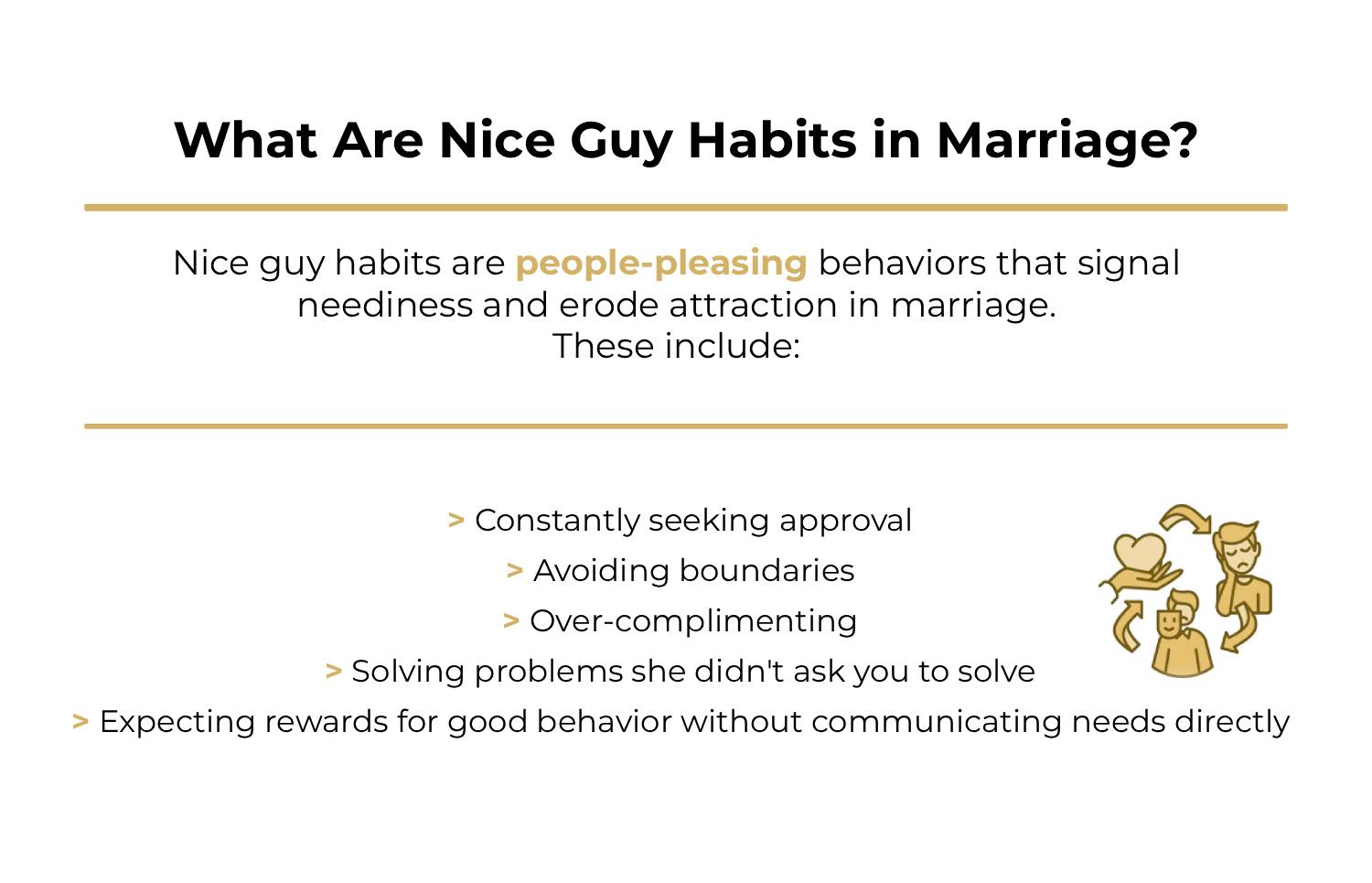
Nice guy habits are people-pleasing behaviors that signal neediness and erode attraction in marriage. These include:
- Constantly seeking approval
- Avoiding boundaries
- Over-complimenting
- Solving problems she didn’t ask you to solve
- Expecting rewards for good behavior without communicating needs directly
These patterns look kind on the surface but signal insecurity underneath. This isn’t about becoming a jerk. It’s about the difference between grounded confidence and desperate approval-seeking.
The truth is, women respond differently than most men think they will. Your wife doesn’t want a man who needs constant validation. She wants a partner who knows himself and leads with calm confidence.
Where Do Nice Guy Behaviors Come From?
The Blueprint Most Men Learned Growing Up
For most men displaying these habits, their father wasn’t in the picture or wasn’t a strong role model. They were mostly raised by their mothers.
When your mother showers you with love, praise, and affection, it creates a specific blueprint. You learn that being accommodating, avoiding conflict, and seeking approval equals love and validation.
This creates what therapists call an anxious attachment pattern. You come to believe you deserve love and respect simply for being nice. And with your mother, that worked perfectly.
Why These Patterns Feel Normal But Don’t Work
Here’s the problem: what works with your mother doesn’t work with your wife.
Your mother loved you unconditionally. Your wife is looking for a partner, not another son.
When you replicate those approval-seeking behaviors with your wife and don’t get the validation you expect, it destroys your reality. You’re confused, frustrated, and asking yourself what you’re doing wrong.
This is why so many men in crisis come to us completely distraught. They don’t understand why their wife is leaving when they’ve done everything right.
The 10 Nice Guy Habits Destroying Your Marriage
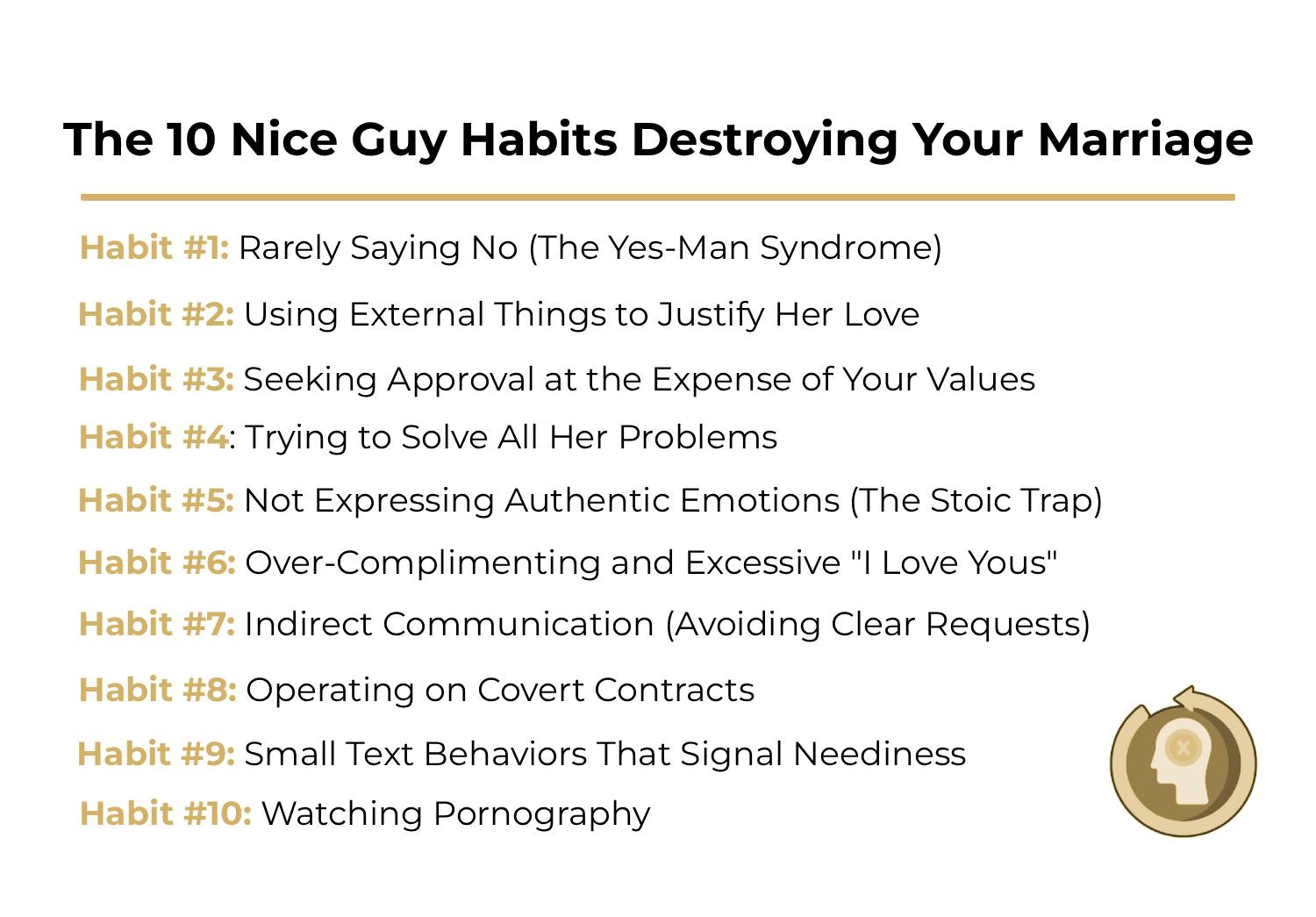
Habit #1: Rarely Saying No (The Yes-Man Syndrome)
If she doesn’t respect you, she will struggle to maintain attraction. And she won’t respect you if you never say no.
You need boundaries because she needs to know who the man she’s with actually is. If you’re constantly saying yes, you’re just like all her friends who say yes all the time.
Here’s a real example: Younger me wanted to go to the gym, but my girlfriend at the time said, “Let’s hang out a little bit first, let’s go get lunch.” I had homework and other commitments, but I didn’t want her to get mad or think we never spent time together. So I went to lunch.
That night I was behind on work, staying up until 2:00 a.m. The next morning I was exhausted and skipped my gym session. The entire week suffered because of that one time I didn’t say no.
Now when my girlfriend asks me to do something that conflicts with my schedule, I say, “Hey, I have a lot of work today. Let’s set a time in the future.” She might get upset in the moment, but she keeps respect for me because she knows how important my commitments are.
What to do instead: Say no to small things first. Practice on low-stakes situations. Notice how respect tends to grow when you stop abandoning yourself.
Habit #2: Using External Things to Justify Her Love
This is the guy who buys his wife a Range Rover or expensive jewelry, then gets angry when she complains about the garbage not being taken out. “I bought you this thing, why aren’t you happy with me? You’re so ungrateful.”
The reason this is needy is that you’re putting all your value on things external to who you are.
Ask yourself this question: If you had nothing, no money, nothing to give her that you usually give her, would she still be with you?
If you’re asking yourself what reason she would have to be with you besides what you provide, I just exposed a deep issue you need to address.
What to offer instead: As a man, just being present in her life, giving her protection and emotional understanding, that’s what she craves more than any vacation or piece of jewelry. Stop assuming external things are the value you provide. They’re minuscule compared to what you can really offer her.
Habit #3: Seeking Approval at the Expense of Your Values
Most guys don’t even know what their top five values are. If I asked you right now to name them, could you?
For reference, mine are confidence, compassion, creativity, integrity, and wisdom. If you cannot name yours off the top of your head, there’s a problem. You must know your values as a man for her to respect you.
Here’s a common scenario: Imagine you’re very religious. You pray, you love your faith. On a date, she says, “I just don’t like religious guys. My parents forced it on me growing up.”
In that moment, many men will hide their beliefs because they’re afraid of conflict or rejection. They put her on a pedestal and become afraid to speak their mind.
But the opposite tends to be true. I’ve seen guys say something completely opposite of what the girl liked, turn it into a joke, and she laughs and has more respect and attraction for him.
The nice guy puts her on a pedestal, is afraid to speak his values, and becomes very agreeable. That’s a feminine trait, and she loses attraction and respect.
What to do instead: Define your top three to five core values. Write them down. Make decisions based on those values, not her mood.
Habit #4: Trying to Solve All Her Problems
Men and women have more commonalities than differences, but one key difference in communication is this: you often communicate to solve problems and achieve goals. Women often communicate to build connection.
When she comes to you with a problem, let’s say she’s complaining about her boss for the hundredth time, your instinct is to offer solutions. “You can quit. You can find a new job. I’ll help you have the conversation with your boss.”
She sits there thinking, “You just don’t listen to me.”
As a nice guy, you’re thinking, “Why doesn’t she understand I’m trying to help?”
Your intention is pure. But by trying to solve her problems, what she gets from that is that she’s not allowed to have those experiences. That you’re uncomfortable with her emotions and trying to get rid of them.
What to do instead: Just listen and offer support. Allow her to feel whatever emotion she’s experiencing. She doesn’t always need solutions. She needs to be heard.
Habit #5: Not Expressing Authentic Emotions (The Stoic Trap)
One of the most damaging pieces of modern relationship advice is that you should be completely vulnerable and cry on your wife’s shoulder about everything going wrong in your life.
The truth is more nuanced. The act of showing emotions isn’t what pushes her away. It’s your perception of what those emotions mean about you as a man.
Here’s the difference: Younger me saw my girlfriend talking to another guy at a party and felt jealous. Instead of bringing it up, I stuffed it down. Maybe I’d go talk to other girls to make her jealous. Maybe I’d pull back affection that night.
She’d ask what’s going on. “Nothing, nothing’s going on.”
That’s needy nice guy behavior.
Now if that happens, I’m open and honest about it. People get jealous. It’s a common emotion. I’d say, “Hey, when you were talking to that guy at the party, I felt a little jealous. I know you weren’t doing anything wrong, but I wanted to be open and honest about that.”
What to do instead: Own your emotions. A grounded man owns every emotion he experiences. Guys don’t want to share their emotions because they’re insecure and afraid of what those emotions will say about them.
Habit #6: Over-Complimenting and Excessive “I Love Yous”
Most girls I’ve dated would say “I love you” all the time. Getting off the phone: “Alright, love you, bye.”
Those three words said constantly become white noise.
My girlfriend now rarely says it, but when she does, it has emotional weight. She actually means it. It’s not just a habit.
Many guys feel like they have to give their wife a compliment when she puts on a dress. Or they say “I love you” not because they’re expressing love, but because they need to hear it back.
Ask yourself: When you’re complimenting her or saying “I love you,” are you doing it for her or for validation?
She knows. You can’t fake it. She knows when you’re upset with her and you say “I love you” that you’re really asking, “Are you going to say it back? Please?”
What to do instead: Only give compliments when you genuinely feel them. The scarcity of your praise will make it more valuable.
Habit #7: Indirect Communication (Avoiding Clear Requests)
It’s better to ask for forgiveness than permission.
I’ve spoken to many women about this, and the kiss scenario is revealing. They’ll say a guy asked, “Can I kiss you?” Zero percent have said yes to that question.
But the guys they do make out with? They just go for it.
You need to face the possibility of rejection. Indirect communication comes from fear. You’re not exactly telling her what you want because if you put it out there and she rejects you, that feeling is uncomfortable.
What to do instead: Be direct about your needs and desires. Stop hinting. Start stating.
Habit #8: Operating on Covert Contracts
This is the unspoken deal you make in your mind that she never agreed to. “Okay, today when I mow the lawn, do the chores, buy you this necklace, and bring home roses, you’re going to have sex with me the rest of the week and not get angry about anything.”
She never signed this contract. She isn’t even aware it exists.
Then when she “breaks” it, you get upset, angry, and pull back. You build resentment over an agreement she never made.
What to do instead: Communicate your needs directly. If you want something, ask for it. Stop keeping score of unspoken expectations.
Habit #9: Small Text Behaviors That Signal Neediness
This one seems small but matters: stop double texting. Don’t text her faster than she texts you. Stop sending excessive emojis.
I know it seems insignificant, but these micro-behaviors signal neediness. They show you’re more invested, more available, more eager than she is.
What to do instead: Match her pace. Be present when you’re with her, but don’t hover digitally.
Habit #10: Watching Pornography
Every time you watch pornography, your brain can’t tell the difference between reality and fantasy. Just like in a dream, it feels like it’s actually happening.
When you’re watching other people have sex and getting off to that, your brain thinks you’re an observer in life. That you can’t go get things yourself.
It’s messing with your dopamine centers. You get instant gratification and immediate pleasure without putting in work. Plus, if there’s shame associated with how you feel afterward, that shame is corrosive.
What to do instead: Quit for 30 days. Your testosterone, your masculine presence, and your confidence will shift. If you take anything from this article, take that one action.
Common Mistakes Men Make When Trying to Change
Mistake #1: Overcorrecting into Jerk Territory
This isn’t about becoming selfish, cruel, or aggressive. Calm confidence doesn’t equal dominance or harshness.
The middle path is kind but boundaried. You can be generous without being a doormat. You can be caring without being needy.
Mistake #2: Expecting Immediate Results
Change takes time. Focus on the process, not the outcome.
Your wife is watching to see if these changes are real or just manipulation. Consistency matters more than perfection. Small shifts compound over time.
Mistake #3: Blaming Her for Your Nice Guy Patterns
These are your patterns to fix. She didn’t create them. You learned them somewhere else.
Stop waiting for her approval to change. This work is about you becoming the man you want to be, regardless of her response.
What to Do Instead: Building Grounded Confidence
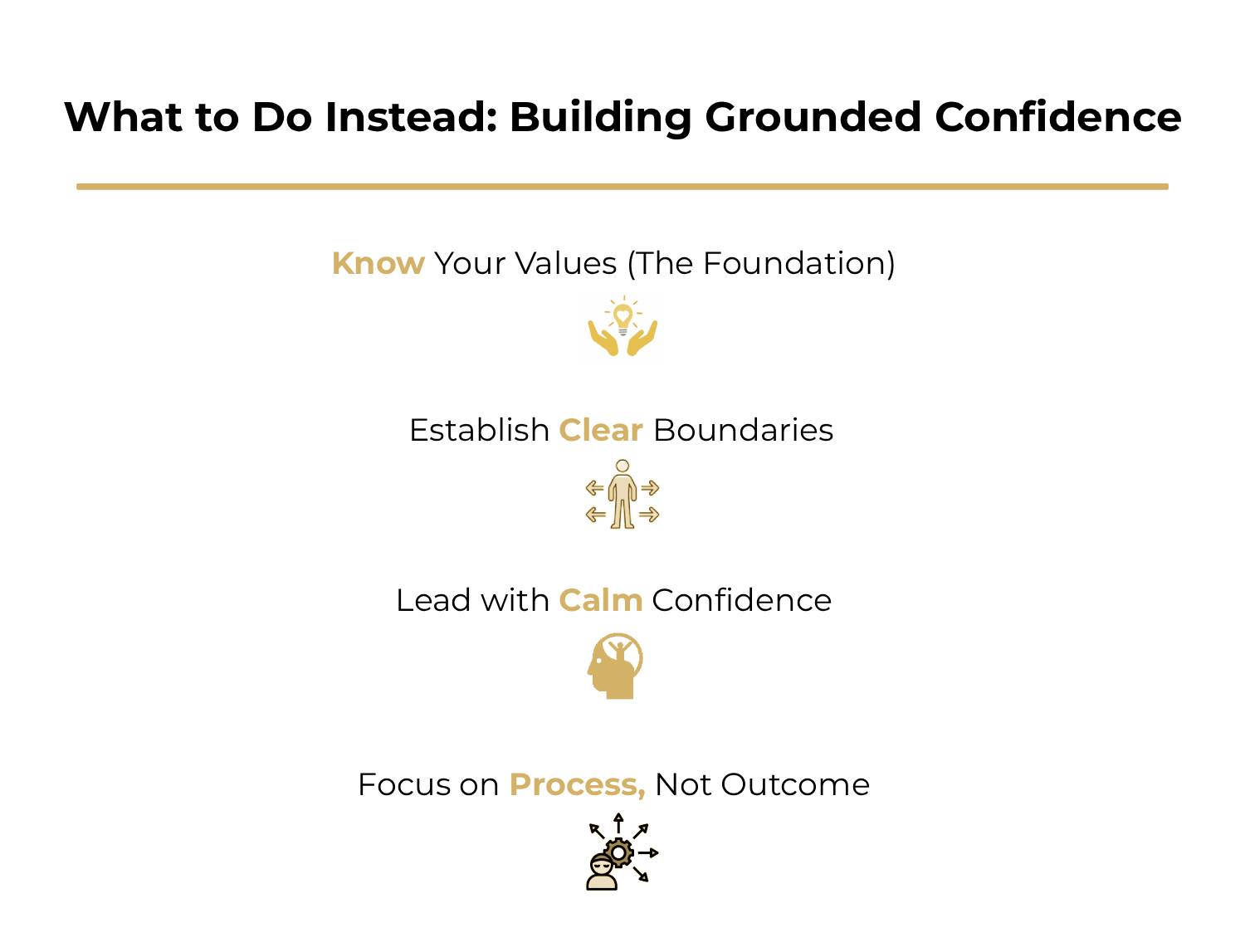
Know Your Values (The Foundation)
Complete this exercise today: Write down 10 values that matter to you. Then narrow it down to your top three to five.
Reference them daily. Make decisions based on your values, not her mood or reaction.
Establish Clear Boundaries
Boundaries aren’t punishments. They’re clarity about who you are and what you stand for.
Practice saying no to small things first. Watch how respect often grows when you stop over-functioning and abandoning yourself.
Lead with Calm Confidence
Make decisions. Invite her input, but don’t need her permission to move forward.
Express emotions without apology. Be direct about your needs and desires.
Focus on Process, Not Outcome
You can’t control her response. You can only control how you show up.
Small consistent shifts create compound effects. Focus on your own growth rather than trying to control her timeline.
FAQ
Isn’t being nice what you’re supposed to do in marriage?
Yes, but there’s a difference between kindness and people-pleasing. Kindness comes from strength and generosity. People-pleasing comes from fear and neediness. Your wife wants a kind man with boundaries, not a doormat.
Won’t setting boundaries make my wife angry?
She might get upset in the moment. That’s normal. But what tends to happen over time is that she develops respect for a man who knows himself and stands firm. Short-term discomfort often leads to long-term respect.
How do I know if I’m being too nice or just being a good husband?
Ask yourself: Am I doing this because it aligns with my values, or because I’m afraid of her reaction? Am I expecting something in return? If you feel resentful after doing “nice” things, you’re likely operating from a needy place.
My wife says she wants me to be more sensitive and communicative. Isn’t that the opposite of what you’re teaching?
She wants you to be emotionally intelligent, not emotionally dependent. There’s a difference between expressing emotions with confidence versus seeking her validation. The first is attractive. The second is draining.
I tried being more assertive once and it backfired. What did I do wrong?
Most men overcorrect into aggressive or controlling behavior. This isn’t about being harsh. It’s about calm, grounded leadership. If it felt forced or angry, that’s why it didn’t work.
How long does it take to see changes in my marriage after stopping these habits?
Every situation is different, but men often report feeling more confident within weeks. Your wife’s response depends on many factors. Focus on your own growth rather than trying to control her timeline.
Take the Next Step
The difference between marriages that drift apart and marriages that reconnect often comes down to one thing: a man’s willingness to examine his own patterns and change how he shows up.
You don’t need to be perfect. You need to be present, boundaried, and authentic. When you stop seeking approval and start living from your values, something shifts. Not just in your marriage, but in how you move through the world.
Results vary based on individual effort, relationship history, and consistency of application. Marriage Reset provides coaching and frameworks. Outcomes depend on your implementation and unique situation.
If you want structured coaching and clear next steps, consider a Marriage Evaluation Call to review your situation and what you can control next. We’ll assess where you are, what’s not working, and map out your specific path forward. This isn’t a high-pressure sales call. It’s a strategy session to see if our approach fits your needs and whether we can help.
DISCOVER THE 5 STEPS TO SAVING YOUR MARRIAGE
Even If Your Wife Already Filed For Divorce


