


10 Nice Guy Habits Secretly Killing Your Marriage
Your wife just said, “I love you, but I’m not in love with you anymore.” She calls you a great father, a wonderful roommate. You work well together on logistics. But the passion, the intimacy, the fire? Gone.
You’re scrambling. You’ve tried logic, therapy, podcasts, books, date nights. Nothing works. Every attempt seems to push her further away.
Here’s what most men don’t realize: you’re not failing because you’re broken or because it’s too late. You’re failing because you’re using the wrong blueprint.
The steps below have helped hundreds of men through our Marriage Reset Program rebuild marriages that looked finished. They’re internal shifts that tend to create natural attraction when your wife sees authentic change.
At the end I’ll share the 6 biggest mistakes that keep men from ever turning things around. Once you see them, you’ll know how to pull her back toward you emotionally instead of watching her drift.
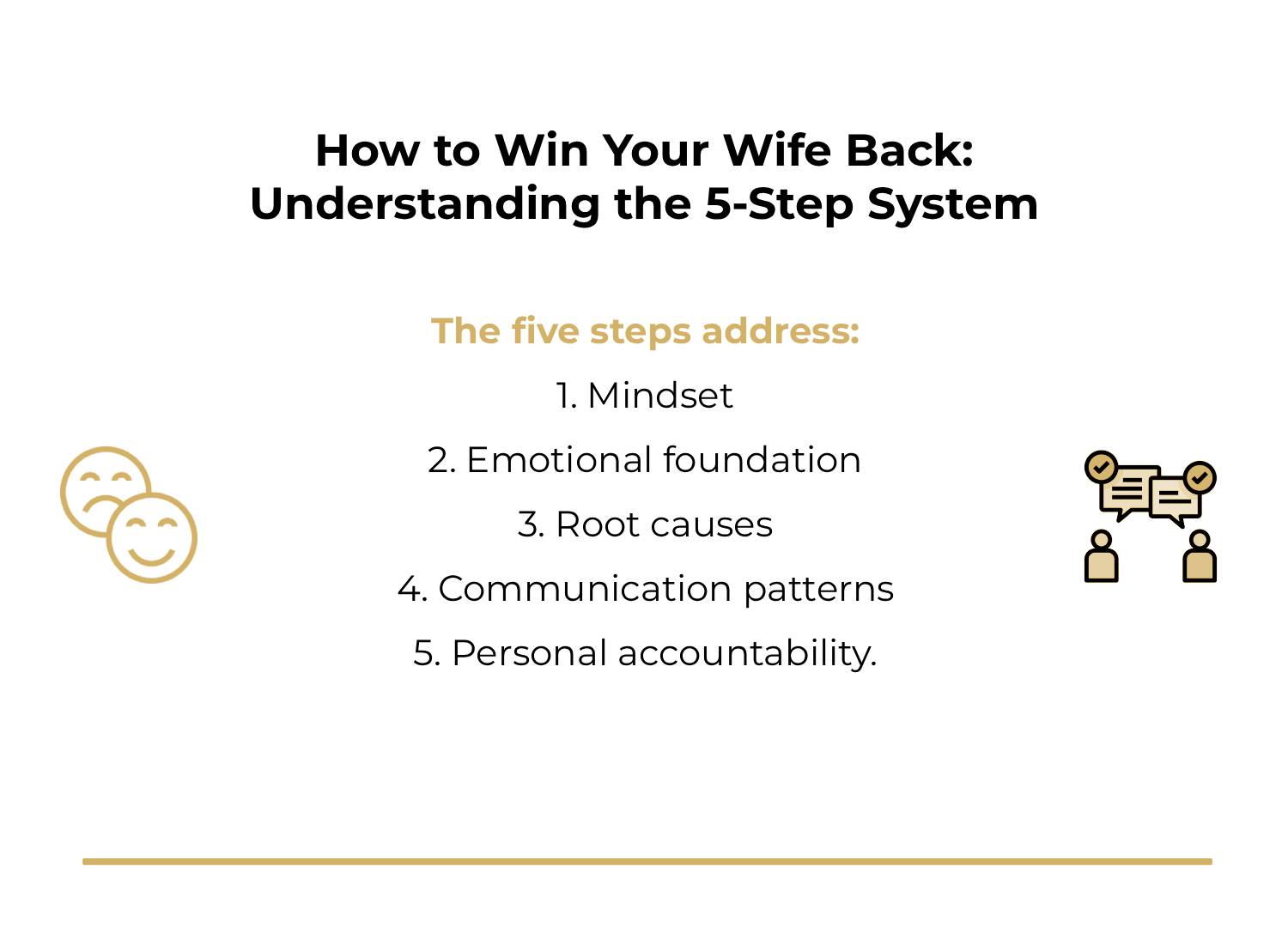
How to Win Your Wife Back: Understanding the 5-Step System
Winning your wife back isn’t about grand gestures or convincing arguments. It’s about systematic internal shifts that rebuild attraction naturally.
The five steps address:
- Mindset
- Emotional foundation
- Root causes
- Communication patterns
- Personal accountability.
They work together as an integrated system, not isolated tactics.
Think of it like rebuilding a house. You need the right blueprint, a solid foundation, an understanding of what caused the damage, the right tools to communicate those changes, and the commitment to see it through regardless of outcome.
Step 1: Develop the Masculine Mindset (Provider + Protector)
Why the Old Blueprint No Longer Works
Seventy years ago, divorce rates were four times lower than today. Men had a clear role: be the provider. Bring home income, stay committed, be reliable. That blueprint worked in a transactional marriage model.
Times changed. No one taught you what modern women need beyond provision. You’ve been operating with your father’s or grandfather’s blueprint in a completely different relationship landscape.
You’re already a provider. You bring home money, you’re a good father, you handle responsibilities. Your wife acknowledged this when she called you a great roommate. But provision alone no longer creates attraction or emotional connection.
The Apex Male Framework
Modern women need two sets of traits:
Provider traits (what you likely already have):
- Financial stability and contribution
- Reliability and follow-through
- Commitment to family
- Practical problem-solving
Protector traits (what’s likely missing):
- Emotional leadership and calm confidence
- Non-reactivity under pressure
- Clear boundaries and assertiveness
- Emotional safety and stability
When you combine both, you create what we call the apex male.
This isn’t about dominance or control. It’s about being someone she feels safe with emotionally. Someone who can handle stress without falling apart. Someone who leads with clarity rather than reacting with defensiveness.
From an evolutionary standpoint, her brain and emotions are wired to respond to this combination. These traits signal you can protect and provide in both practical and emotional ways.
Practical Application
Audit yourself honestly:
- Do you react defensively when she’s upset or do you stay calm?
- Do you make decisions confidently or defer everything to avoid conflict?
- Do you set boundaries or people-please to keep the peace?
- Do you handle problems proactively or wait for someone else to lead?
Most men score high on provider, low on protector. That imbalance is likely a major factor in why she’s pulling away.
Step 2: Build the Foundation of Forgiveness
Why Resentment Destroys Your Best Efforts
Imagine you have the right blueprint now. You’re building the house correctly with all the right materials. But you forgot to check the foundation. If resentment sits underneath everything, the structure will collapse.
Resentment is like corrosive acid between you and your wife. After years together, you’ve both done things that caused hurt, betrayal, and trauma. If you haven’t truly forgiven her, it shows up in your tone, your reactions, and your triggers.
Here’s what it looks like in practice: you say 99% of the right words in a conversation. Then she says something with the wrong tone. You snap. That one triggered moment undoes everything and you’re back in the cycle of arguing and bickering.
One of our clients struggled with this. His wife had an emotional affair. They were rebuilding and making progress.
One evening he asked her to take out the trash. She went to the kitchen but got a text message and stopped to respond. Five minutes later he walked in, saw her on her phone, and exploded. “You’re not listening to me again.”
That one moment caused a massive blowout and destroyed weeks of positive progress.
If he had truly forgiven her for the emotional affair, that phone moment wouldn’t have triggered him. He would have seen it as a minor distraction, not proof she didn’t respect him.
The Blind Man Metaphor
Picture this: you’re walking down the street with a scalding hot cup of coffee. Someone bumps into you. Coffee spills all over your shirt. It hurts. You’re furious. You turn to confront the person and see dark glasses on the ground to his left, a walking stick to his right.
Your heart changes instantly. It melts. It softens. Why? Because you now know he’s blind. He didn’t intentionally hurt you.
Your wife is the blind man. When she did things that hurt or betrayed you, she wasn’t thinking about you. She was thinking about herself. She didn’t see how her actions would affect you. That doesn’t excuse what happened, but it changes your perspective enough to release the resentment.
How to Actually Forgive
Forgiveness is a decision, not a feeling. You decide to let go of the right to hold past hurts against her. Here’s how:
- List specific grievances. Write them down. Be honest about what hurt.
- Reframe intent. For each one, acknowledge she was acting from her own pain, not from a desire to destroy you.
- Release the debt. Consciously decide you won’t bring it up in future arguments or hold it over her.
- Notice your tone. When you’ve truly forgiven, your tone shifts. You stop being triggered by small things.
This doesn’t mean you trust blindly or ignore red flags. It means you stop operating from a place of resentment that sabotages every conversation.
Step 3: Diagnose the Divorce (Find the Root, Not the Branches)
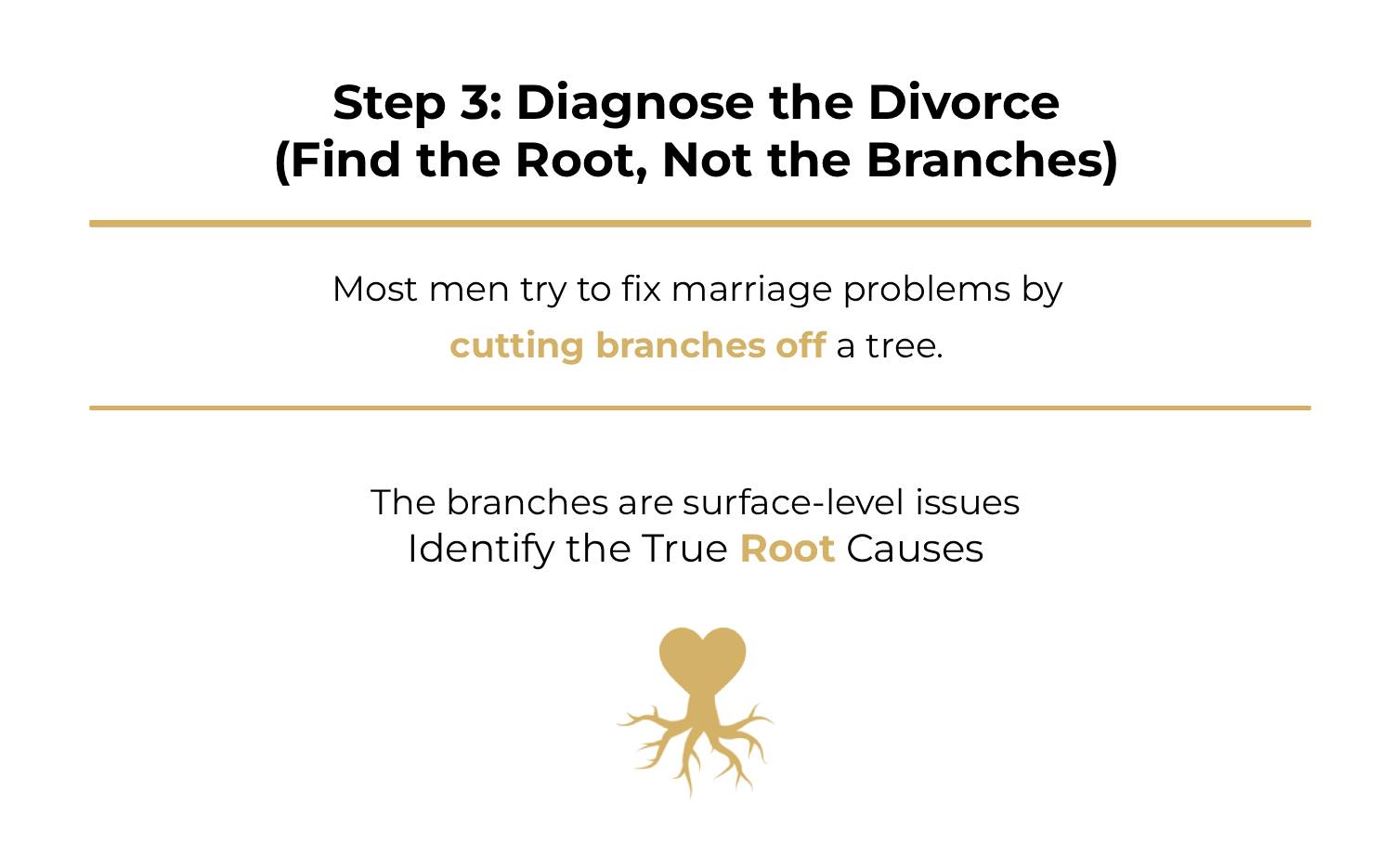
Stop Fighting Over Surface Issues
Most men try to fix marriage problems by cutting branches off a tree. The branches are surface-level issues: money, kids, chores, sex, religion, in-laws.
You think, “If I just solve this money problem—open a joint account, get a promotion, figure out a better budget—things will improve.”
But if resentment is the root, solving the money branch won’t work. She’ll just find another branch to focus on. The arguments will shift to chores, then to parenting styles, then to how you spend your free time. The branches are symptoms, not causes.
Identify the True Root Causes
The real roots typically include:
- Emotional neglect over time. You provided practically but didn’t connect emotionally.
- Years of complacency. You stopped dating her, pursuing her, making her feel special.
- Failure to meet emotional needs. She needed you to understand her feelings, not fix her problems.
- Breakdown of emotional safety. She doesn’t feel safe being vulnerable with you because you react defensively or dismissively.
Diagnostic Questions to Ask Yourself
- When exactly did she start pulling away? What was happening in your life or marriage at that time?
- What emotional needs went unmet? Not financial or physical needs, but emotional ones like feeling heard, valued, desired, safe.
- Where did you show up as provider but fail as protector? Where did you handle logistics but ignore her emotions?
Once you identify the root, the branches lose their power. She stops finding new reasons to justify why the marriage won’t work because you’re addressing what actually matters.
Step 4: Master Communication (Understanding the ETS Scale)
The Emotional Tipping Scale Explained
Communication is the medium through which you convey change and heal conflict. But most men communicate logically when they need to communicate emotionally.
The ETS Scale (Emotional Tipping Scale) explains why she seems to have checked out suddenly. Picture a scale with two sides:
Positive emotional investments:
- The first kiss
- Early dates and romance
- Your wedding
- Having children together
- Quality time and laughter
- Moments she felt seen and valued
Negative emotional investments:
- Years of complacency
- Arguments and criticism
- Emotional neglect
- Not spending meaningful time together
- Dismissing her feelings
- Making her feel like a burden
Early in your marriage, the ratio was probably 4:1 positive to negative. She could handle occasional conflicts because the positive far outweighed it. Over time, through death by a thousand cuts, that ratio shifted to 2:1, then 1:1, then the scale tipped.
Why She “Suddenly” Wants Out
It wasn’t sudden. It was gradual. But once negative emotional investments outweighed positive in her subconscious mind, something shifted.
She didn’t consciously decide this. One day she looked at you and you were more a source of stress than love. You became the villain, not the hero.
That’s why she rewrites history and can only remember negative moments. Her brain is protecting her from staying in what feels like an emotionally unsafe situation.
Potency Actions
The way to shift the ETS Scale back is through mechanisms like we use in the Marriage Reset Program:
Potency Actions: These are high-impact intentional behaviors that shift the scale dramatically. They’re not random acts of kindness like flowers or date nights. They’re behaviors that address the specific emotional needs she’s been missing. For your specific marriage, those actions will be unique based on what caused the disconnection.
To identify the right CLC reports and potency actions for your situation, you need to understand what obstacles caused your marriage to reach this point. That’s where personalized coaching makes a difference.
Step 5: Rise to the Apex (Take Full Accountability)
The One Trait Every Man Who Succeeds Has
One of our clients recently told his therapist about his progress. The therapist said,
“This is unheard of. People don’t reconcile this strong and this fast. Two weeks in and you’re saying you’re more in love with her than you’ve been in years.”
I can tell within the first two to three minutes of a call whether a man will win his wife back. It’s not about his situation. Some of the worst situations turn around. It’s about one thing: accountability.
Every man who succeeds says some version of this:
“Even if I don’t win her back, I’m still making these changes. I accept that the marriage is where it’s at because of my behavior. If I change my behavior, I’ll get a new result.”
When I hear that, I know he’ll likely succeed. When I hear blame, excuses, or “she changed, not me,” I know he’ll struggle.
The Apex Gas (The Fuel You Can’t Be Given)
Think of this framework as a truck. I can give you the engine, the wheels, the right parts. But I can’t give you the gas. The fuel is your commitment and accountability. That has to come from you.
You can learn every technique, memorize every script, and understand the psychology perfectly. But if you’re doing it to control her response, it won’t work.
If you’re doing it because you recognize you need to become a better man regardless of whether she comes back, you’ll likely see results.
Making Changes for You, Not for Her
This is the paradox: when you stop needing her to change and focus entirely on your own transformation, she often responds naturally. When you make changes to manipulate an outcome, she senses it and pulls away further.
Your mindset needs to be:
“I’m becoming the man I should have been all along. If that wins her back, great. If it doesn’t, I’m still better for it.”
That shift, from outcome-chasing to internal growth, is what separates men who turn things around from men who drive their wife away.
Common Mistakes That Push Your Wife Further Away
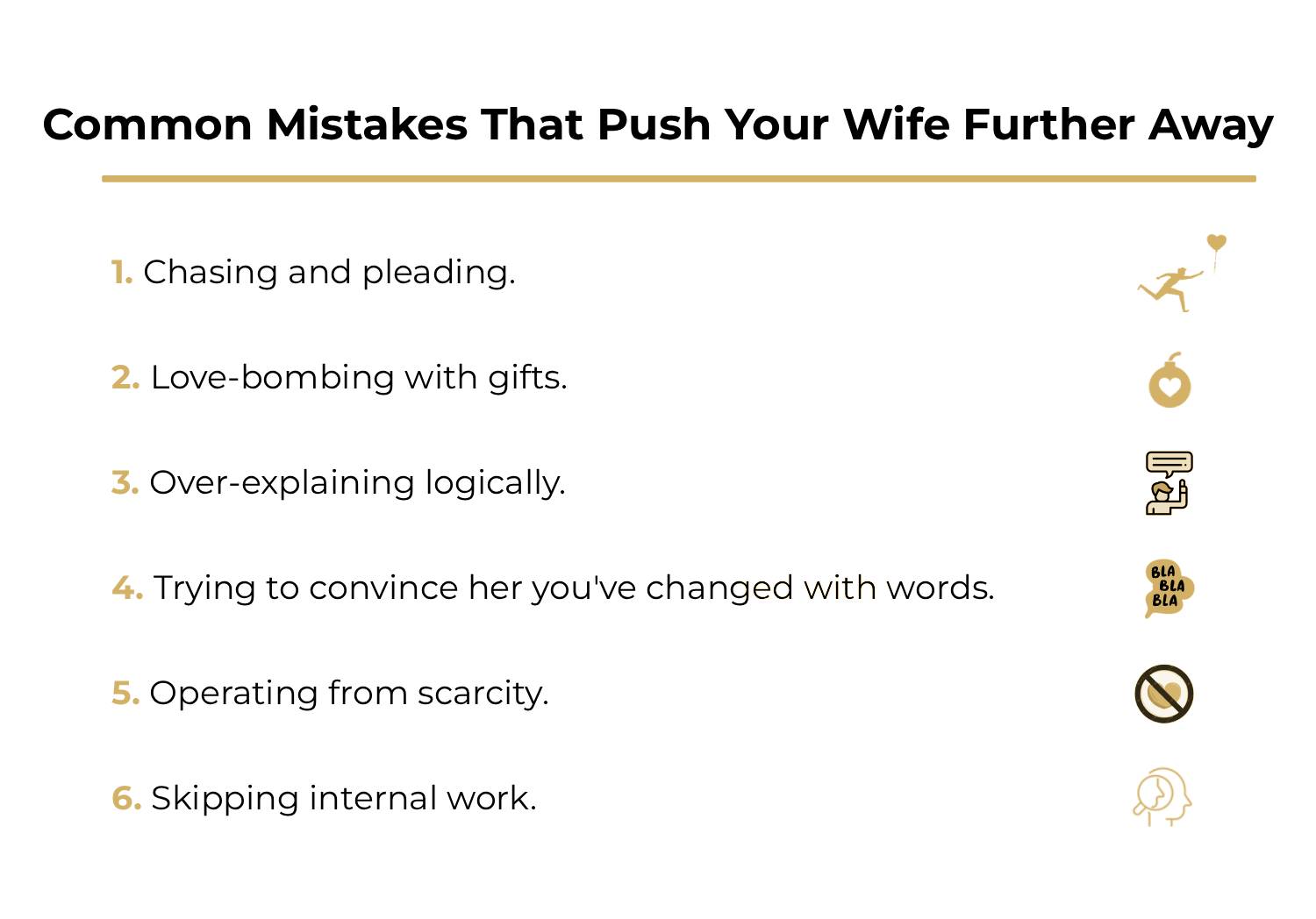
Even with good intentions, these mistakes will sabotage your progress:
Chasing and pleading. The more desperate you seem, the less attractive you become. Desperation signals low value and emotional instability.
Love-bombing with gifts. Flowers, jewelry, surprise trips. These are external tactics that don’t address internal disconnection. She doesn’t want more stuff. She wants you to show up differently.
Over-explaining logically. You can’t logic someone back into love. “Here are ten reasons why we should stay together” doesn’t work because attraction is emotional, not logical.
Trying to convince her you’ve changed with words. Words are cheap. She’s heard promises before. She needs to see evidence over time through your actions and reactions.
Operating from scarcity. Acting like she’s your only option; like you can’t survive without her. This creates pressure and repels her. Confidence, even in uncertainty, is attractive.
Skipping internal work. Jumping straight to tactics and techniques without addressing your mindset, forgiveness, and accountability. The internal work is the foundation everything else rests on.
What Happens When You Get This Right
When men implement this framework consistently, patterns emerge:
Respect tends to return first, then attraction. She starts noticing you’re different. Conversations become easier because you’re not reactive or defensive. She feels safer opening up because you’re not trying to fix or control her emotions.
Physical intimacy often returns as emotional connection rebuilds. Not because you’re performing perfectly, but because she feels drawn to you again. You feel confident and grounded regardless of her response, which creates natural attraction.
Most importantly, you create a marriage worth staying in, not just one you’re both tolerating to avoid divorce. That distinction matters. You’re not holding it together through willpower. You’re rebuilding something both of you actually want.
FAQ
How long does it take to win your wife back?
Results vary based on disconnection severity and your consistency. Many men in our Marriage Reset Program report noticeable shifts within two to four weeks when they fully commit to this framework. Rebuilding deep trust and attraction often takes two to six months of sustained effort. The key factor is genuine transformation, not surface changes.
What if my wife has already filed for divorce or moved out?
Separation or legal proceedings don’t automatically mean it’s over. Many men we’ve worked with were in exactly this situation. The framework still applies because it focuses on your transformation first, which creates space for her to reconsider. The further gone she seems, the more critical Steps 1 (mindset) and 5 (accountability) become.
Can I win my wife back if she won’t go to therapy or coaching with me?
Yes. This is a key differentiator of the Marriage Reset approach. Our ERM Method starts with your transformation, not joint sessions. When you change how you show up emotionally, she often responds without needing initial couples therapy. Eventually involving her in the process tends to accelerate results. Many wives become willing to engage once they see authentic change, not just words.
Is this manipulation? Am I just playing games?
No. Manipulation is about controlling her emotions or decisions. This framework is about genuine self-improvement that naturally creates attraction. You’re not pretending to be someone you’re not. You’re becoming the version of yourself that she and you need. The changes are internal and authentic, not performative tricks. If your motivation is “how do I control her,” this won’t work. If it’s “how do I become a better man and husband,” this is the path.
What if I’ve already tried everything and nothing worked?
Most men have tried external solutions: flowers, date nights, apologies, therapy, love languages. Those approaches often fail because they’re tactical, not systematic. They don’t address root causes or the emotional investment imbalance (ETS Scale). This framework is different because it starts with internal transformation before moving to communication and behavior. Men who’ve “tried everything” often haven’t tried this approach because it requires letting go of ego and taking full ownership.
How do I know if it’s too late?
It’s rarely truly too late until divorce is finalized and she’s fully moved on emotionally with someone else. Even then, we’ve seen cases where these principles helped men create healthy closure or, in some situations, eventual reconciliation. The real question isn’t “Is it too late?” but “Am I willing to do the deep work regardless of the outcome?” If your answer is yes, there’s hope.
Your Next Step
Your wife saying “I’m not in love with you anymore” isn’t the end. It’s a wake-up call. The five steps in this framework (masculine mindset, forgiveness foundation, root cause diagnosis, communication mastery, and apex accountability) have helped hundreds of men rebuild marriages that seemed hopeless.
The key is starting now and committing fully, not trying halfway.
If you want structured coaching and clear next steps for your specific situation, consider booking a Marriage Evaluation Call with our team. We’ll assess where your marriage stands, identify the specific obstacles keeping you stuck, and map out the potency actions that apply to your unique dynamics. This isn’t a sales pitch. It’s a strategy session to help you understand what you can control next.
Results vary based on individual effort, relationship context, consistency, and your wife’s willingness to engage over time. Marriage Reset provides coaching, frameworks, and support. Outcomes depend on your genuine commitment to transformation and the unique dynamics of your marriage.
DISCOVER THE 5 STEPS TO SAVING YOUR MARRIAGE
Even If Your Wife Already Filed For Divorce


