


How to Save Your Marriage When She Wants a Divorce
When your wife says “I want a divorce,” your first instinct is to panic. You apologize, promise to change, try to convince her to stay.
But here’s what most men discover too late: those reactions push her further away.
I’ve worked with hundreds of men who’ve saved their marriages after this exact moment. Some in as little as three weeks. One client went from hearing “I want a divorce” on her birthday to her asking “when are we having kids?” just six weeks later.
Another man made significant progress in three weeks, even though his wife had been talking to another guy for months.
In this article, you’ll learn the three habits these men used to move the needle from “it’s over” to reconnection, even when their wife was seeing someone else or refused to talk.
Why She Really Wants a Divorce (It’s Not What She Says)
One client remembers the exact moment everything fell apart.
It was February 1st—his wife’s birthday. She looked him in the eye and said,
“I want a divorce.”
Two weeks later, she said it again.
He later found out she’d been talking to another guy for months.
Suddenly, things were making sense. Until he discovered the affair wasn’t the cause. It was a symptom of something he’d missed for years.
The deeper truth is emotional, not logical; and most husbands miss it completely.
In the next sections, you’ll learn the three habits that uncover the real reasons—so you stop chasing symptoms and start fixing what’s actually broken.
Habit #1: Understanding the Female Mind
Men and women have fundamental differences in how they communicate, process emotions, and express needs. Ignore these differences and you’ll miss what she’s actually saying and needing from you.
She Speaks in Indirect Terms
Women tend to communicate indirectly because being direct feels conflictual. This is where the whole concept of “reading her mind” comes from.
Here’s a real example from one of the men I worked with. His wife would say in an angry tone,
“Why haven’t you taken the trash out?”
But when she wasn’t upset, she’d say more softly,
“Somebody needs to take the trash out.”
He started joking that her nickname for him was “somebody.” It’s funny, but it illustrates an important point.
Most women speak in indirect terms. “Somebody should take out the trash” is actually a specific request coded in softer language. She’s telling you what she needs without creating direct conflict.
Once you understand her indirect communication style, you can respond more effectively. You overcome communication problems and create stronger emotional connection.
How Women Request Space
Here’s another core difference. One client explained that his wife told him,
“I’m going to be out there watching TV. When you feel like coming to talk to me, come and talk to me.”
He didn’t listen. He hovered over her. He kept asking what was wrong. He didn’t let her feel her feelings and calm down.
Many women need time to process their emotions. If you’re the anxious type who just wants to solve problems immediately, you will suffocate her and push her further away. This client recognized how his wife operated with her emotions, so he gave her the space she needed.
Action Step: When she makes an indirect statement or request, pause before responding. Ask yourself, “What is the emotional need or specific action she’s actually requesting?” Then respond to that, not to your interpretation or frustration.
Habit #2: Identifying the Core Issue (Not the Symptom)
Your wife doesn’t leave because of dishes, late nights at work, or forgetting anniversaries. Those are symptoms. She leaves because she doesn’t feel emotionally safe with you, doesn’t respect your leadership, or has lost the attraction she once had.
Why Women Give Logical Reasons That Aren’t Real
When you ask a woman why she’s leaving and force her to give logical answers, she ends up saying surface-level things. “You never did dishes over the years” or “you were always late home from work.”
This makes men think, “Wait, you’re leaving me because of those reasons? I can fix those.” But in reality, that’s not the core reason.
She’s not lying. It’s just hard for her to put the real reason into words.
You must address the real reason.
The most common core issues are:
- Emotional reactivity
- Neediness
- Loss of masculine frame
- Complacency.
These destroy emotional safety and respect over time.
Taking Full Responsibility Without Defense
One client took full responsibility early on. He thanked his wife for showing him he’d been coasting in the relationship. He actively fought against complacency by setting up nightly check-in talks and taking consistent action to create passion.
That’s what worked. He identified the problems, created actions to overcome them, and did it consistently. That’s why he got such good results.
Notice he didn’t defend himself. He didn’t say “but I was working hard for the family” or “you changed too.” He took ownership of his part and set up consistent actions, not one-time grand gestures.
Action Step: List out your wife’s complaints. Now ask, “What core emotional need is not being met that creates these complaints?” That’s where you focus your energy.
Habit #3: The Masculine Mindset (Want Her, Don’t Need Her)
The most powerful shift you can make is internal: moving from “I can’t live without her” to “I want her, but I’ll be okay either way.” This isn’t about not caring. It’s about becoming the man she can respect and be attracted to again.
Creating Emotional Safety Through Presence
One of your wife’s most important emotional needs is a sense of safety with you. One client described his breakthrough this way:
“It was my calm demeanor… staying neutral and non-judgmental in every interaction with her.”
Every time you’ve gotten reactive, shut inward, stonewalled, left the room, or become super needy, you’ve shown her you’re not in your masculine grounded presence. She’ll see you as either emotionally unavailable (like a rock) or as another woman if you’re anxious and begging.
This creates a disconnect in what I call polarity. The more you’re in your masculine—calm, grounded, steady—the more she goes into her feminine—open, happy, trusting with you.
The Respect and Attraction Connection
Women are only attracted to men they respect. They only respect men who want them but don’t need them.
When you put her on a pedestal, when you emotionally become a beggar trying to convince her to stay, she sees you as below her. You’re being needy, and she will not be with a man she looks down upon.
The shift you need is this: from “I can’t live without her” to “I want her AND I’ll be just fine.”
When you truly feel you’ll be okay on your own—even a superstar on your own—you’ll start to behave like the man she’ll want.
Understanding Where Neediness Comes From
It took me about ten years and thousands of dollars in graduate school to understand where my neediness came from. I remember dating a girl early on who wouldn’t text me back for a couple hours. I’d sit there re-analyzing the text, asking myself if I said the wrong thing. I’d interpret how I might have said it wrong and draw out long catastrophic scenarios.
When I was with her and she responded positively, I felt okay again. She made me feel like I was good enough. I was basing my internal worth on external validation because I didn’t feel good enough inside.
This is how neediness shows up in marriage. You try to convince her to stay. You emotionally bargain. You need her validation to feel okay about yourself.
You can spend years in graduate school learning this, or you can identify the source of that neediness with structured guidance and reorient your masculine nature.
Reclaiming What You Already Had
Here’s what most men don’t realize. Every guy had this masculine grounded presence with his wife when he first met her, whether he knew it or not. That’s why she was initially attracted to you.
Over the years, you became complacent. You stopped being that man. This isn’t about becoming someone new. It’s about returning to who you were—removing the neediness and reactivity that buried your natural confidence.
Action Step: Next time she’s upset or pulling away, practice this: Take a breath. Get grounded. Respond from “I care about you AND I’m okay” rather than “I need you to feel better so I can feel better.” This small shift changes everything about how she experiences you.
What Actually Happens When You Implement These Habits
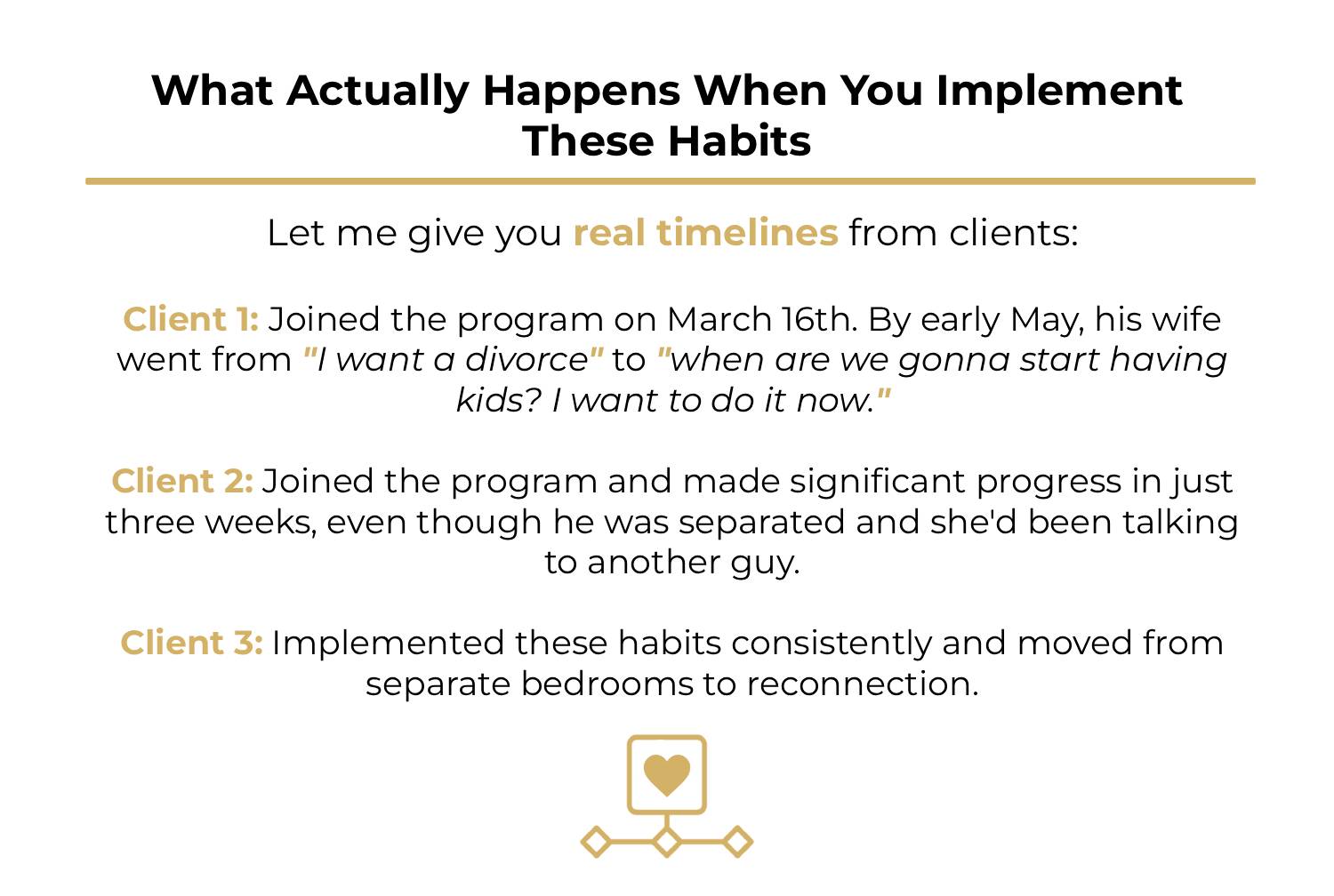
Let me give you real timelines from clients:
Client 1: Joined the program on March 16th. By early May (about six weeks), his wife went from “I want a divorce” to “when are we gonna start having kids? I want to do it now.”
Client 2: Joined the program and made significant progress in just three weeks, even though he was separated and she’d been talking to another guy.
Client 3: Implemented these habits consistently and moved from separate bedrooms to reconnection.
What tends to change when you implement these habits:
- She starts initiating conversation again
- Physical space decreases naturally (moving from separate rooms to the same bed)
- Intimacy returns (emotional first, then physical)
- She looks at you differently—with respect and warmth instead of contempt or indifference
- Conflicts decrease because you’re not reactive
- She begins to reinvest in the relationship
Results vary with effort, context, and consistency. These habits create the conditions where reconnection often happens. They don’t force outcomes.
Common Mistakes That Push Her Further Away
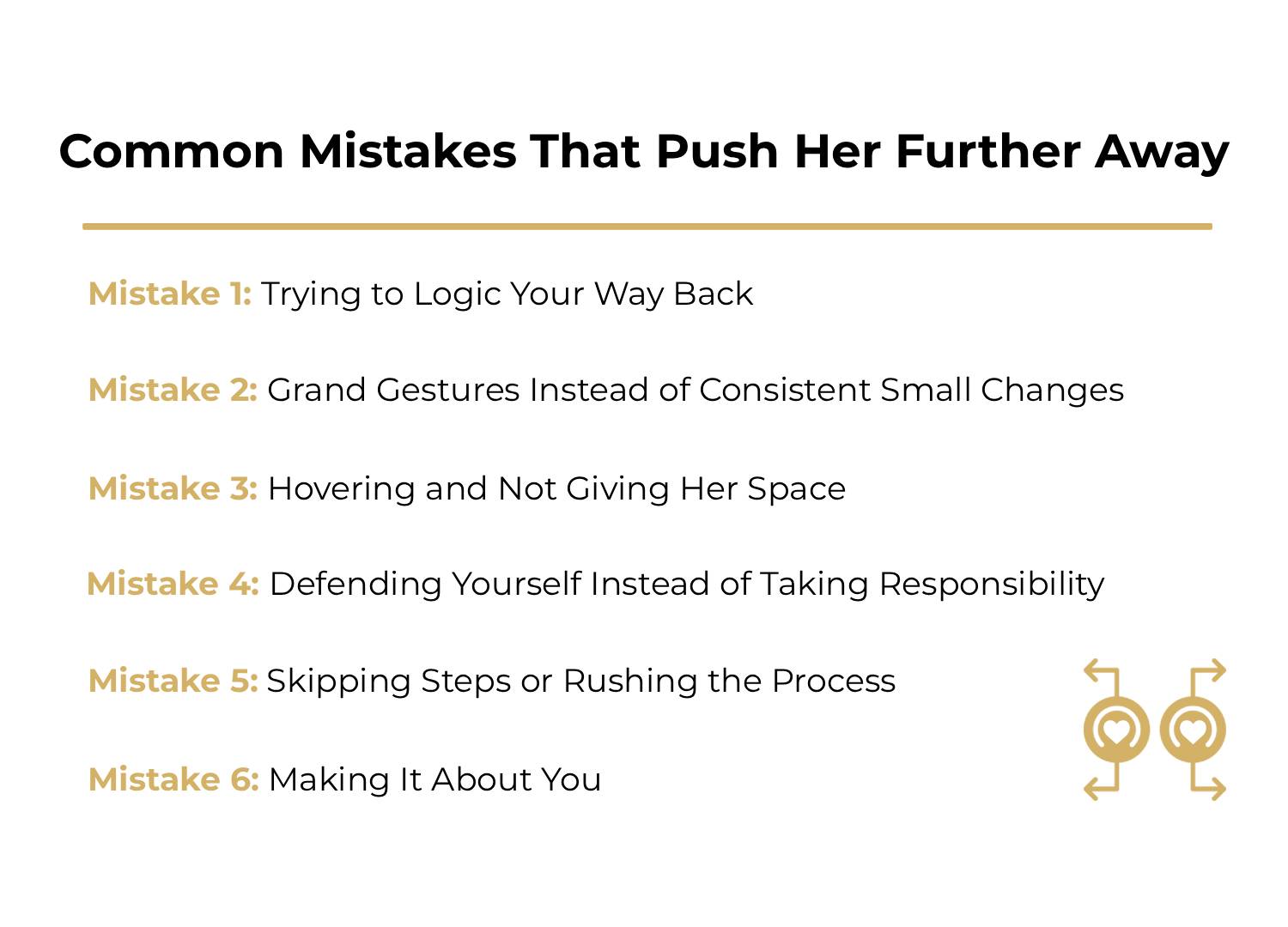
Mistake 1: Trying to Logic Your Way Back
“But you said it was the dishes!” This doesn’t work because dishes aren’t the real issue.
Mistake 2: Grand Gestures Instead of Consistent Small Changes
Buying flowers once doesn’t fix months of emotional disconnection. Consistent daily presence does.
Mistake 3: Hovering and Not Giving Her Space
She needs time to process emotions. When you hover and try to fix her feelings immediately, you suffocate her.
Mistake 4: Defending Yourself Instead of Taking Responsibility
“But I was working for the family” might be true, but defensiveness prevents you from addressing the real issue.
Mistake 5: Skipping Steps or Rushing the Process
One client gave this advice to his past self: “Do the program exactly the way it is. Cover everything. Do it twice if you have to. Don’t skip ahead. It will work.”
Mistake 6: Making It About You
“What about what I need?” is valid, but if your marriage is in crisis, you must lead the repair first.
The ERM Method: A Framework for Emotional Resetting
These three habits form the foundation of the Emotional Reset Method (ERM). This approach differs from traditional marriage therapy in several ways:
- It starts with what you control – your internal state and external presence
- It works even when she refuses to participate – you don’t need her permission to start
- It addresses masculine-feminine polarity – the dynamic that created attraction initially
- It focuses on core issues, not symptoms – you stop wasting energy on surface fixes
The ERM Method helps you identify your specific patterns of neediness and reactivity, then gives you practical frameworks to rebuild emotional safety, respect, and attraction.
FAQ
Can I really save my marriage if she’s already talking to another guy?
Yes. Several men in our program have reconnected with their wives even after discovering emotional or physical affairs. When you address the core issues that created the disconnection (not the affair itself, which is a symptom), you often create conditions where she naturally reinvests. The affair usually happens because she’s already emotionally disconnected. Fix the disconnection and the affair tends to lose its appeal. This requires you to focus on your own transformation, not trying to control her choices.
What if my wife won’t talk to me or refuses to participate in fixing the marriage?
This is actually common and doesn’t prevent progress. These three habits start with what you control—your mindset, your presence, your communication patterns. Many men see their wife’s attitude shift within weeks simply because they stopped being reactive, needy, and focused on symptoms. One client said the key was “giving her space—not just physical, but emotional and spiritual space.” When you stop pressuring her to engage and instead become the grounded, attractive man she married, she often naturally moves toward you.
How is this different from marriage therapy?
Marriage therapy requires both people to participate and often focuses on surface-level communication skills. This coaching approach targets the masculine-feminine dynamic that created attraction initially, and it works even when she refuses to participate. It’s action-oriented (not just talking about feelings) and addresses core emotional patterns, not symptoms. This is coaching for husbands specifically, using frameworks hundreds of men have successfully implemented.
How long does it actually take to see results?
This varies based on your situation, effort level, and consistency. Some men see shifts in their wife’s behavior within two to three weeks. Others need six to eight weeks of consistent implementation. The men featured in this article saved their marriages in three to eight weeks. What matters most is that you implement the habits fully and consistently, not that you rush or skip steps trying to force a timeline.
Your Next Step
You now understand the three core habits that helped men save their marriages when divorce seemed inevitable: understanding female psychology and indirect communication, identifying core issues instead of symptoms, and developing the masculine mindset that wants without needing.
These aren’t theories. They’re proven frameworks that hundreds of men have used to shift from “she wants divorce” to reconnection, often in six to eight weeks. The men you read about in this article went from separate bedrooms and affair discoveries to “when are we having kids?” and genuine reconnection.
The question is: what will you do with this information?
You can try to implement these habits on your own—reading articles, watching videos, figuring it out through trial and error. Or you can get direct guidance to identify your specific core issues and create your custom roadmap.
If you want structured coaching and clear next steps, consider a Marriage Evaluation Call to review your situation and what you can control next. On the call, we’ll identify your specific core issues (not symptoms), map out your custom roadmap, and show you exactly what tends to work in situations like yours—whether she’s already moved out, filed papers, or refuses to engage.
One client reflected on his experience: “Your personality comes out as we talk and this really solidifies that I made the best choice in my life.” Another said, “The thing I would tell my past self is: do the program exactly as it is, don’t skip ahead, and it will work.”
Results vary based on individual effort, relationship context, and consistency of implementation. Marriage Reset provides coaching and proven frameworks. Outcomes depend on your unique situation and how you apply what you learn. We make no guarantees about specific results.
We only work with men who are serious about saving their marriage and committed to doing the work.
DISCOVER THE 5 STEPS TO SAVING YOUR MARRIAGE
Even If Your Wife Already Filed For Divorce


