


How You Feel
If you’re checking your wife’s phone at 2 AM, replaying the betrayal in your mind during work meetings, or wondering if your marriage can survive this—you’re dealing with something over 90% of couples face at some point. Trust issues destroy more marriages than the actual betrayal ever could.
Here’s the part most men miss: betrayal itself doesn’t kill marriages. Your response after the betrayal determines whether trust rebuilds or whether you spiral into suspicion, resentment, and eventual separation.
After working with hundreds of men over the last decade, the pattern is clear. Successful marriages don’t avoid betrayals. They have the ability to restore trust once it breaks. And when trust rebuilds properly, your marriage often becomes stronger than before the betrayal happened.
This article walks you through the three-step framework that tends to restore trust, even in marriages where infidelity, emotional affairs, or repeated lies have created deep wounds.
Understanding What Trust Actually Means
Trust is the confident assumption that your partner will act in your best interest. Not that they’re perfect, or that they’ll never hurt you. But when faced with choices, they’ll choose actions that protect the relationship rather than damage it.
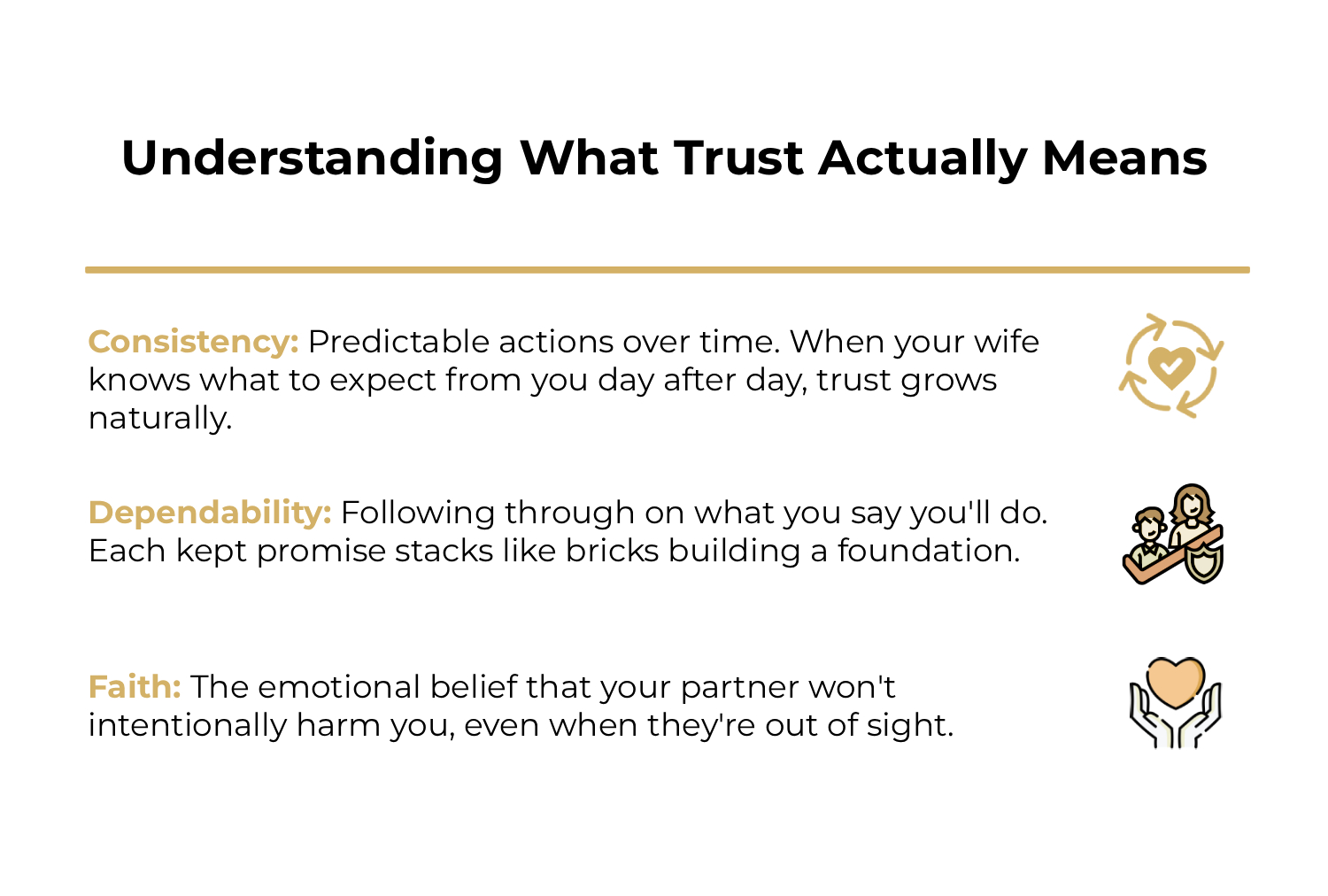
Trust breaks down into three components:
Consistency: Predictable actions over time. When your wife knows what to expect from you day after day, trust grows naturally.
Dependability: Following through on what you say you’ll do. Each kept promise stacks like bricks building a foundation.
Faith: The emotional belief that your partner won’t intentionally harm you, even when they’re out of sight.
When betrayal happens, all three components take damage. But here’s what matters: the harm to your marriage isn’t the betrayal itself. It’s how you respond in the days, weeks, and months after.
Why Your Response After Betrayal Matters More Than the Betrayal
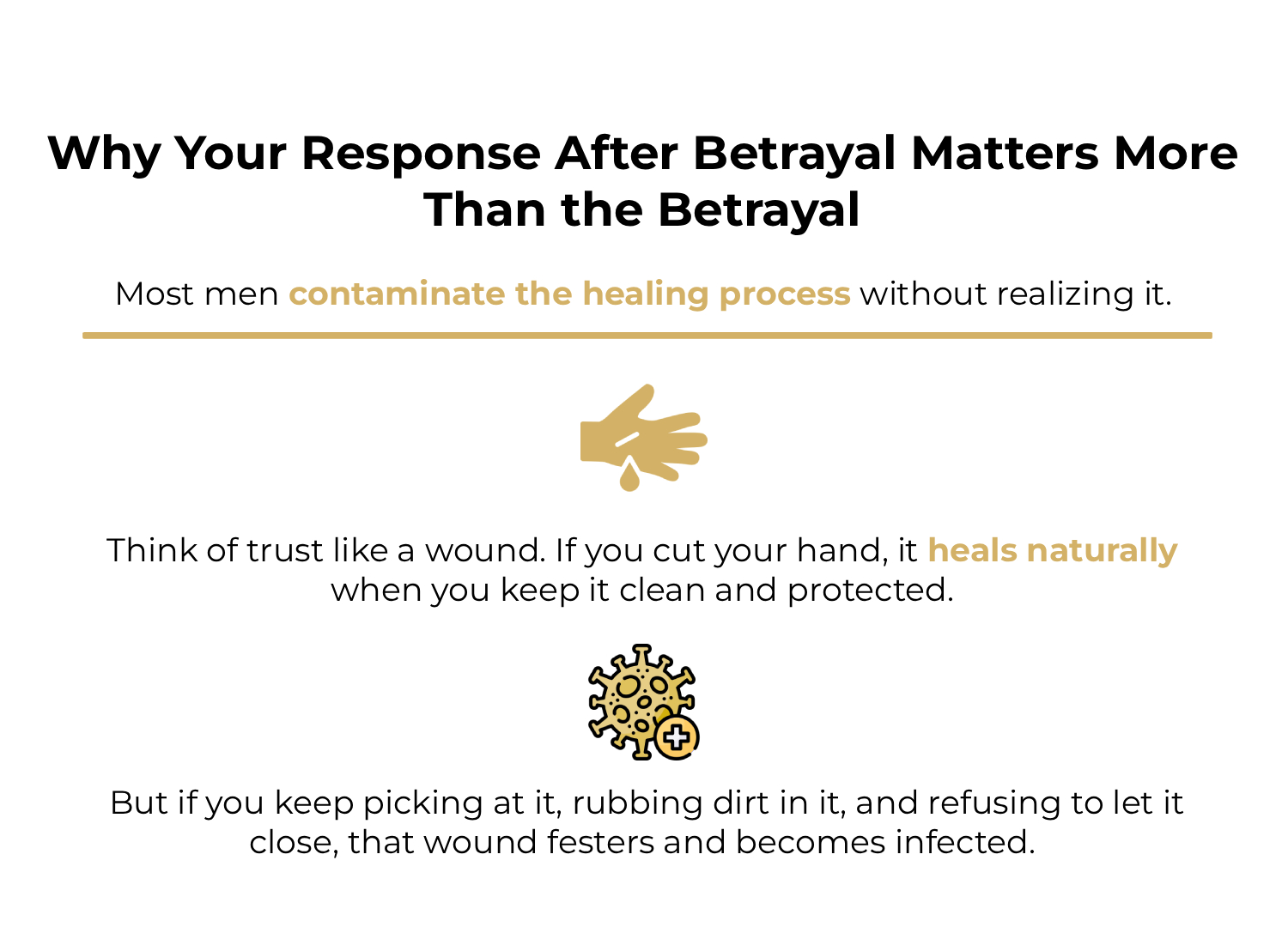
Think of trust like a wound. If you cut your hand, it heals naturally when you keep it clean and protected. But if you keep picking at it, rubbing dirt in it, and refusing to let it close, that wound festers and becomes infected.
Most men contaminate the healing process without realizing it.
The Real Damage Comes From What Happens Next
I worked with a client recently whose wife had an emotional affair with a coworker. The affair itself lasted three weeks. The damage he created by responding poorly lasted six months.
He went through her phone daily. He called her repeatedly when she was out. He brought up the affair in every argument. Each of these actions communicated the same message: “I don’t trust you, and I never will.”
His wife felt constantly accused, constantly on trial. The distance between them grew wider even though she’d ended the affair and wanted to rebuild.
The breakthrough came when he understood this: his suspicious behaviors were feeding the exact distance and resentment he feared most.
The Suspicion Spiral That Pushes Her Away
When you act like your wife will betray you, you create a self-fulfilling cycle.
Your mind jumps to worst-case scenarios when she texts someone. You track her location. You interrogate her about her day. You look for evidence of lies even in innocent conversations.
These behaviors don’t protect you. They push her away.
Here’s why: your actions create emotions, and your emotions drive more actions. The more suspicious you act, the more anxious you feel. The more anxious you feel, the more you seek control through checking, tracking, and questioning.
Your wife picks up on this energy even when you think you’re hiding it. She feels distrusted. She feels controlled. And ironically, that feeling of being constantly suspected creates the very distance you’re trying to prevent.
One client described it perfectly: “I was so certain she was cheating that I started texting her ex-boyfriend from her phone to try to catch her. I literally pushed her toward him by acting like she was already gone.”
That’s the suspicion spiral. And breaking it requires conscious, deliberate action.
The 3 Steps to Restore Trust in Your Marriage
These steps work whether you broke the trust or she did. They work whether the betrayal was physical, emotional, or repeated lies. The framework remains the same because trust rebuilds the same way regardless of who caused the damage.
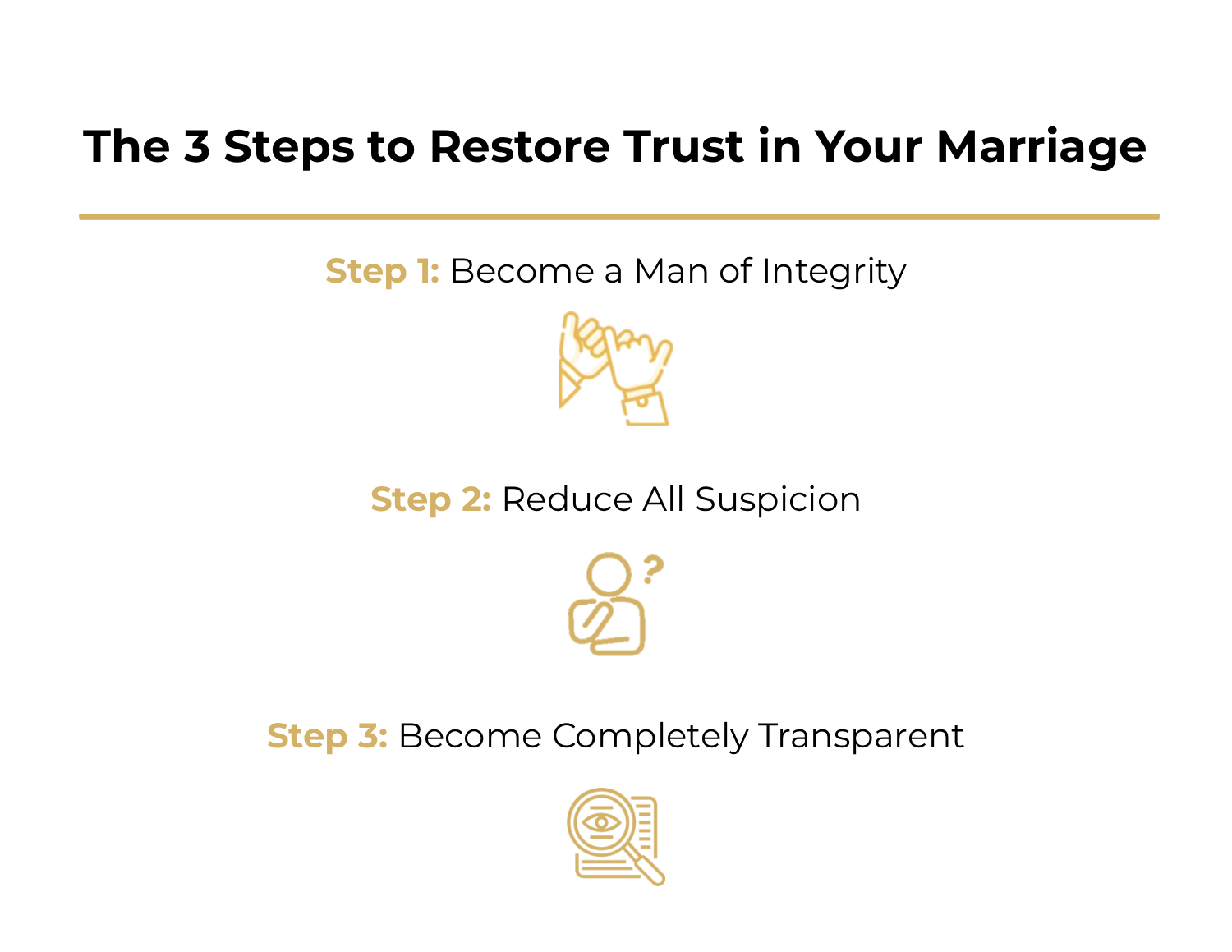
Step 1: Become a Man of Integrity
Integrity means doing what you say you will do. Every time. In every area of your life.
Think about the last month. How many times did you tell your wife you’d handle something and then forget? Pick up milk at the store. Fix that broken drawer. Call about the insurance issue. Take the kids so she could rest.
Your wife tracks these micro-failures consciously or unconsciously. Each broken promise erodes trust even when the promise seems small.
And guess what? When you can’t trust yourself to follow through, other people struggle to trust you too.
Start here:
- Make a list of 5-10 things you said you’d do but haven’t done yet
- Choose 2-3 of those items
- Complete them today, before you go to bed
Don’t announce it. Don’t ask for credit. Just do the things you said you’d do.
This builds trust in two directions. First, you prove to yourself that you’re reliable. Second, your wife notices (even if she doesn’t say anything) that you’re becoming the kind of man who follows through.
The quote that changed this for me: “How you do anything is how you do everything.”
When you become a man of integrity in small things, people start trusting you with bigger things.
Step 2: Reduce All Suspicion
This step is hard because it requires letting go of control when you feel most vulnerable.
Stop going through her phone. Stop tracking her location. Stop asking loaded questions designed to catch her in a lie. Stop analyzing her tone when she talks about her day.
I know what you’re thinking: “But what if she’s still lying? What if I stop checking and miss something important?”
Listen: your suspicious behaviors aren’t protecting you. They’re feeding a monster.
Picture a creature with horns and a tail, growing bigger every time you feed it. That’s what suspicion becomes. The more you check her phone, the more anxious you feel. The more anxious you feel, the more you need to check again. The cycle feeds itself.
And here’s what happens on her end: your wife isn’t always conscious of why she feels distant from you. She just knows she feels watched, controlled, distrusted. That feeling creates emotional distance. And distance often leads to the exact behaviors you fear most.
A script for the hard moment:
When you feel the urge to check her phone, pause and ask yourself: “Is this action building trust or contaminating the wound?”
If the answer is contaminating, choose something else. Go for a walk. Do pushups. Call a friend. Anything that breaks the pattern of feeding suspicion.
One client told me: “The day I stopped checking her phone was the day she started opening up to me again. It’s like she could breathe for the first time in months.”
Trust heals when you stop making it worse.
Step 3: Become Completely Transparent
This step flips the script. Instead of obsessing over her transparency, you focus on becoming completely open yourself.
Remove passwords from your phone. Share access to financial accounts. Come forward immediately when something happens that could create suspicion.
Most men have something they’re hiding. Not necessarily affairs or major lies, but small secrets: a separate bank account she doesn’t know about, deleted text conversations, places you go without mentioning them.
You might think: “Those things don’t matter. It’s not like I’m doing anything wrong.”
But hidden things erode trust at a subconscious level. Your wife picks up on evasiveness even when she can’t name what’s wrong. The energy of secrecy creates distance.
Think about communication in marriage like this: the daily words and actions you see are about 2% of what’s happening. The other 98% is emotional, subconscious, hormonal, spiritual. Everything you hide influences that deeper level of connection.
Transparency doesn’t mean oversharing every thought or giving play-by-play updates. It means removing barriers that create suspicion.
Practical transparency checklist:
- Remove phone passcodes or share access freely
- Talk about your day without being asked
- Show her financial accounts and spending without defensiveness
- Come forward when something could look suspicious before she asks
- Admit mistakes immediately rather than waiting to be caught
When you lead with transparency, you create space for her to do the same. You can’t control whether she reciprocates, but you can control whether you’re modeling the trust you want to rebuild.
Common Mistakes That Keep Trust Broken
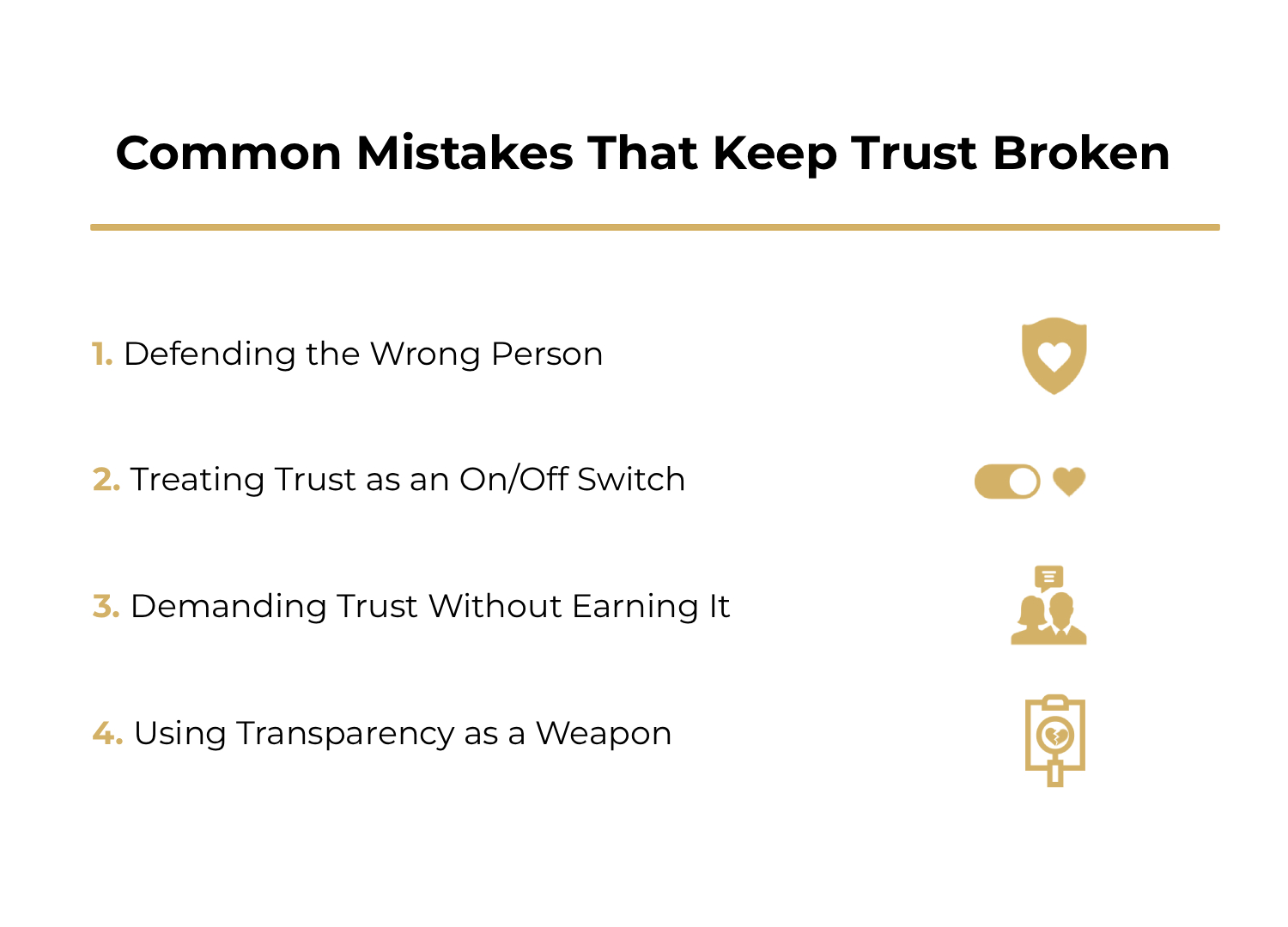
Defending the Wrong Person
After a betrayal, your wife needs to know you’re on her side. Not that you’re defending the other person, explaining their intentions, or minimizing what happened.
I made this mistake years ago. I flirted with another woman at a party. My girlfriend was hurt. Instead of validating her feelings, I defended the other woman: “She didn’t mean anything by it. She’s just friendly like that.”
That response damaged trust more than the original action. My girlfriend needed me to prioritize her feelings over protecting someone else. She needed to know I understood why it hurt and that I was firmly in her corner.
When betrayal happens, take her side completely. Even if you think she’s overreacting. Even if you feel the situation is more nuanced. Your job in that moment is to validate her pain, not argue with her reality.
Treating Trust as an On/Off Switch
Trust doesn’t return all at once. It rebuilds in layers through consistent actions over time.
Many men expect: “I’ve been transparent for two weeks. Why doesn’t she trust me yet?”
Because trust is like stacking bricks. Each dependable action adds another brick. Each kept promise builds the foundation higher. But it takes time to rebuild a structure that was knocked down.
Think of it like training for a marathon. You don’t run 42 kilometres on day one. You build endurance gradually through consistent effort.
Trust works the same way. Small deposits. Daily consistency. Patience with the process.
Demanding Trust Without Earning It
Some men approach trust restoration like this: “I said I’m being honest now. She needs to just trust me and move on.”
That’s not how trust works.
Trust is earned through demonstrated reliability over time. You can’t demand it. You can’t logic your way into it. You have to build it through actions that prove you’re trustworthy.
If your wife is hesitant to trust you, that’s a normal response to betrayal. Don’t punish her for being cautious. Instead, prove through your behavior that caution is no longer necessary.
Using Transparency as a Weapon
Transparency becomes manipulative when you use it to demand reciprocal access or when you announce it constantly to get credit.
“I’m being completely open with you. Why won’t you do the same?”
That approach creates pressure and resentment. It turns transparency into a transaction rather than a genuine shift in how you show up.
Lead with transparency because it’s the right way to rebuild trust, not because you’re keeping score.
What Successful Trust Restoration Actually Looks Like
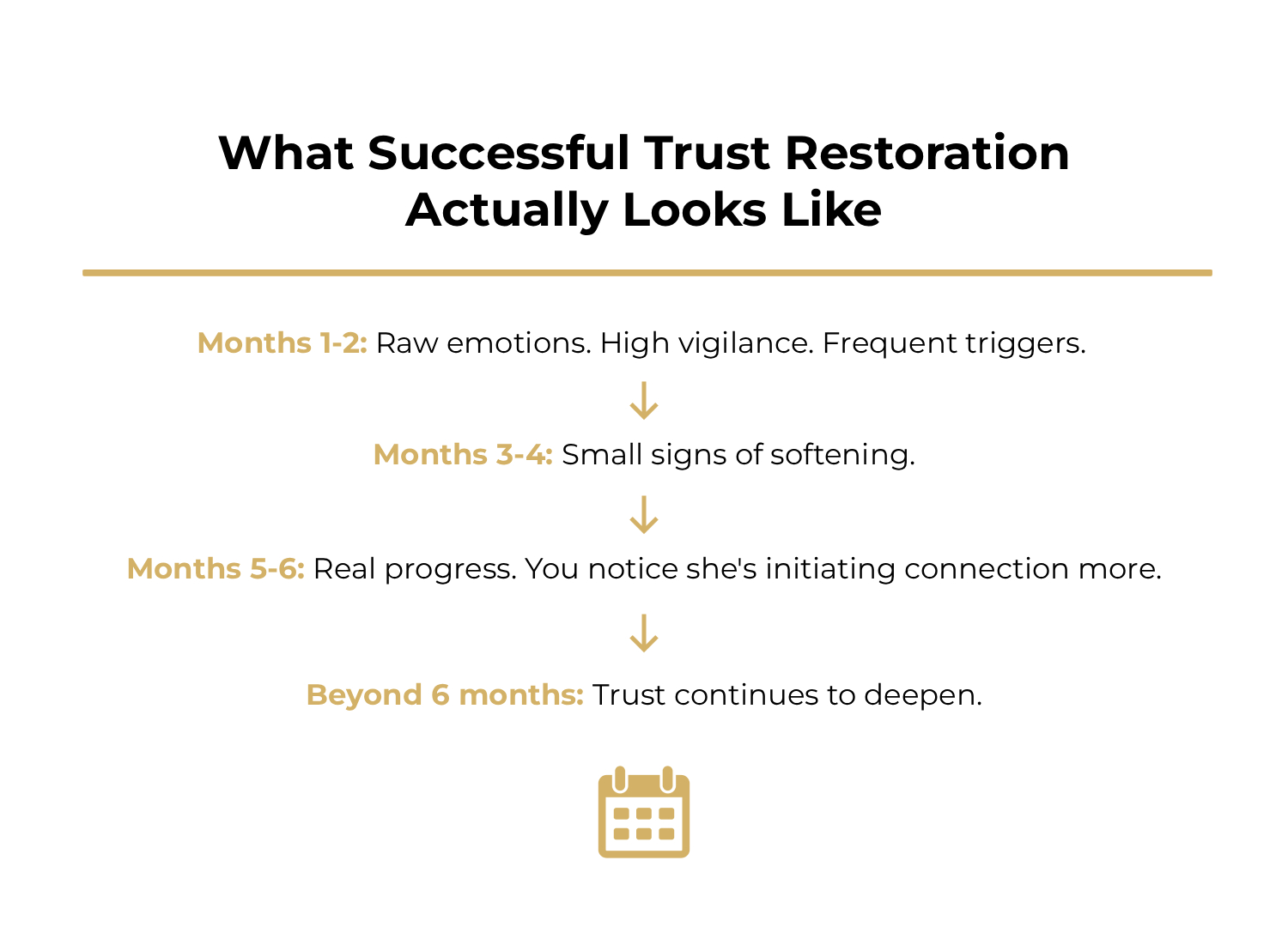
Trust restoration isn’t linear. You’ll have good weeks and hard weeks. Progress often looks like: three steps forward, one step back, two steps forward, one step back.
But over time, patterns emerge:
Months 1-2: Raw emotions. High vigilance. Frequent triggers. Your job is consistency and patience. Keep following through. Keep being transparent. Don’t expect much visible progress yet.
Months 3-4: Small signs of softening. She checks your phone less. Conversations feel slightly easier. The emotional charge around triggers starts to decrease.
Months 5-6: Real progress. You notice she’s initiating connection more. The relationship feels less fragile. Trust is rebuilding in small but noticeable ways.
Beyond 6 months: Trust continues to deepen. The relationship often becomes stronger than it was before because you’ve both learned how to navigate hard things together.
This timeline varies based on the severity of betrayal, how much contamination happened after, and how consistently you implement these steps. But the pattern holds true: trust heals when you stop making it worse and start building it intentionally.
It’s a lot like working out. When you lift weights, you create micro-tears in your muscles. Those tears make you weaker temporarily. But with proper nutrition, rest, and recovery, your muscles rebuild stronger than before.
Betrayal creates tears in your marriage. The question isn’t whether tears happened. It’s whether you’re creating the conditions for proper healing and rebuilding.
FAQ
Can you rebuild trust after infidelity?
Yes, trust tends to rebuild when both partners stop contaminating the healing process. The key is consistent integrity, reduced suspicion, and complete transparency over time. Most men working with coaches see meaningful progress within 3-6 months when they apply this framework consistently.
How long does it take to rebuild trust in a marriage?
There’s no fixed timeline because every situation differs in severity and how much damage occurred after the betrayal. Most couples see real progress within 3-6 months of consistent work. Trust rebuilds brick by brick through dependable actions, not through time alone.
What if my wife won’t stop hiding things from me?
Focus on your own transparency first. When you eliminate suspicious behaviors and consistently demonstrate integrity, you create space for her to reciprocate. Often, hiding behavior is a response to feeling controlled or distrusted. Lead by example rather than demanding change you haven’t modeled yourself.
Should I stay in a marriage where trust was broken?
Only you can make that decision based on your values and circumstances. However, studies show over 90% of couples experience trust issues at some point. The determining factor isn’t whether betrayal occurred but whether both partners have the ability to restore trust afterward. If you’re willing to take responsibility for your response and implement these steps, rebuilding is often possible.
Take the Next Step
When you focus on these three steps consistently, trust tends to heal naturally. Your marriage often becomes stronger than before because you’ve developed the ability to navigate hard things together.
Ask yourself: Are you willing to do the work that restores what was broken?
If you want structured coaching and clear next steps for your specific situation, consider booking a Marriage Evaluation Call. On that call, we’ll review where your marriage is now, what’s been working and what hasn’t, and the specific actions that tend to work for men in your situation. No pressure, no guarantees—just honest assessment and a clear path forward if coaching makes sense for you.
DISCOVER THE 5 STEPS TO SAVING YOUR MARRIAGE
Even If Your Wife Already Filed For Divorce


