


Why She's Cold With You But Warm With Everyone Else
You’ve watched it happen. Your wife laughs with the neighbors, lights up around her friends, softens with the kids. Then you walk into the room and her whole demeanor shifts. The warmth drains. The walls go up.
You’re not imagining this.
When a woman feels emotionally unsafe with her husband, she closes off as a form of self-protection. It’s not calculated or conscious. It’s automatic. And the confusing part is that your attempts to fix things – being nicer, doing more chores, planning date nights, having “the talk”- often make it worse.
Here’s why: those approaches don’t address what she actually needs.
She needs to feel emotionally and psychologically safe with you. That’s the foundation. Without it, nothing else can grow.
If you’ve tried everything and she still pulls away, you’re not crazy. You’re just addressing symptoms instead of the root cause. The good news is that the root cause is something you can influence once you understand how.
In this article, you’ll learn three specific shifts in how you show up that tend to help wives feel safe enough to open up and reconnect. These are the same principles hundreds of men in the Marriage Reset Program have used to turn things around, even when their wives seemed completely done.
How to Make Your Wife Happy Again: The Foundation
To make your wife happy again, focus on three shifts: respond instead of react to her emotions, create psychological safety by validating her feelings without fixing them, and provide structure through calm leadership in daily decisions. These shifts help her feel understood and safe enough to open up emotionally.
Let’s break down each one.
Shift #1: Respond Instead of React
The Pattern That’s Keeping Her Closed Off
Your wife comes home stressed about her boss. She vents about how her manager dismissed her ideas in front of the whole team. Your immediate response: “Why don’t you just talk to HR?” or “Have you tried documenting everything?” or “Maybe you should look for a new job.”
You think you’re being helpful. You’re trying to make her feel better. But here’s the message she’s actually receiving underneath your words: You should not feel this way.
This is the difference between responding and reacting. When you react, you panic. You see her upset and your instinct is to fix the problem so the discomfort goes away. But women process emotions differently than men. When she shares a problem, she’s not asking you to solve it. She’s seeking connection and validation.
Why Solution Mode Backfires
There’s a concept in communication theory called punctuation. Think of your wife’s emotions as flowing energy. When she expresses something difficult- frustration, hurt, disappointment- that emotion needs to be acknowledged and reflected back before it can move through and release.
When you validate her feeling, you punctuate it. The emotion gets to complete its cycle. She feels seen and heard, which creates safety. But when you immediately jump to solutions, you’re essentially putting up a wall. You’re pushing the emotion away. She feels discarded, which reinforces that her feelings aren’t safe with you.
This is why she keeps bringing up the same issues. The emotions never got validated, so they never got resolved. They’re stuck.
The Framework That Works
Here’s the simple formula that changes everything:
“You feel [emotion] because [reason].”
That’s it. No “but” afterward. No solutions tacked on. Just pure validation that you see what she’s experiencing.
Let’s look at real examples:
What doesn’t work:
- “Why don’t you just tell your boss how you feel?”
- “You’re overreacting about what my mom said.”
- “I’m sure it’s not that bad.”
What does work:
- “You feel unappreciated because your boss doesn’t see all the work you’re putting in. I don’t know how you deal with that.”
- “You feel hurt because you wanted to feel included by my family.”
- “You feel overwhelmed because you’re carrying all of this alone.”
Notice the difference. You’re not agreeing that the boss is terrible or that your mom was wrong. You’re simply acknowledging the emotion she’s experiencing and connecting it to the reason behind it. This is what creates safety.
The Hardest Part
The urge to fix is a panic response. You see her in pain and you want to make it stop. That urge is natural, but it’s also what’s been keeping you stuck. When you can recognize that urge and resist it- when you can sit with her difficult emotions without trying to change them- that’s when you become safe.
Get out of your logical, solution-based mindset with your wife. She doesn’t need you to fix her problems. She needs you to understand her feelings first.
Shift #2: Create Safety by Becoming the Shore
The Foundation Women Need
Emotional and psychological safety is the number one need a woman has in a relationship. It’s the bottom rung of everything else. Without it, attraction doesn’t happen. Respect doesn’t grow. Intimacy doesn’t return.
And here’s what most men don’t realize: every time you avoid her difficult emotions, every time you get defensive when she criticizes you, every time you shut down or walk away, you’re teaching her that those emotions aren’t allowed. That she’s not safe to be fully herself with you.
So she closes off.
You Are the Shore, She Is the Ocean
Here’s the metaphor that helps men understand this: Your wife is the ocean. She’s a storm of emotions that shift and change. Sometimes the ocean is calm and gentle, softly caressing the shore. Those are the good days when she’s happy and warm. You love those days.
But sometimes those same emotions crash violently into the shore. She’s upset, critical, stressed, overwhelmed. The waves are rough and raging.
You are the shore. You’re the solid, unmovable base that remains stable regardless of how the waves come in.
When you retreat from her difficult emotions- when you avoid conflict, shut down, or run away- she learns that parts of her aren’t acceptable. That she needs to keep those emotions contained or you won’t be there. And if you won’t be there for her difficult emotions, she can’t trust you to lead. She can’t soften. She has to stay in her masculine energy to protect herself.
What This Looks Like in Real Life
She says: “You never listen to me. I feel like I have to walk on eggshells around you.“
Your instinct: “What are you talking about? I’ve never hurt you! I’m here every day trying to make you happy!”
This is defensiveness. It’s natural. It also confirms to her that she’s not safe to express her true feelings because you can’t handle them without making it about defending yourself.
Here’s what responding looks like instead:
“You feel alone and unseen. That must be really painful. Tell me more about what you’re feeling right now.“
You’re not admitting you’re a bad husband. You’re not agreeing with everything she’s saying. You’re creating space for her to be vulnerable by showing that you can handle her full emotional range without shutting down or getting defensive.
The Path to Becoming That Man
The best way to become the shore – the stable base she can trust – is to master your own difficult emotions first. If you can’t handle your own anger, frustration, shame, or fear, you won’t be able to stay grounded when she brings hers to you.
This doesn’t mean you become emotionless. It means you become regulated. You feel your emotions without being controlled by them. You stay present even when things are uncomfortable. That’s what safety looks like to her.
Shift #3: Provide Structure Through Calm Leadership
The Leadership Paradox
Here’s something that confuses a lot of men: You’re married to a strong, independent woman. She handles things at work. She manages the household. She makes decisions all day long. So when you defer to her at home- “Whatever you want, honey”- you think you’re being respectful.
But it’s making her unhappy.
Here’s why: When she comes home, she doesn’t want to keep being in that masculine, decision-making mode. Her default state has become masculine because you haven’t stepped up to lead. And the more she has to make decisions, the more exhausted and resentful she becomes.
Decision-making takes mental energy. It burns calories. When you constantly defer to her or say “I don’t care,” you’re making her carry that weight. She wants to relax. She wants to drop into her feminine energy. But she can’t if you’re not holding the structure.
A Real Example
One client’s wife was choosing paint colors for their bedroom. She’d narrowed it down to three options but couldn’t decide. The husband thought, “I’ll make her happy by giving her total freedom. I’ll say she can choose whatever she wants.”
He said: “I don’t care, babe. Whatever makes you happy.”
This stressed her out. What he should have said: “I think we should go with this one, but if you think otherwise, I’m all ears.”
See the difference? He’s making a decision while still inviting her input. He’s leading while being considerate. That’s what she’s looking for.
The 3-2-1 Leadership Technique
Here’s a practical framework you can use starting today:
- Present 3 options (restaurants, weekend activities, vacation ideas)
- Ask her to choose her top 2
- You make the final decision from those 2
This gives her voice and autonomy while you maintain leadership. It shows you’re considering her preferences while taking responsibility for the final call.
How to Implement This Daily
Ask yourself: “How can I add 10% more leadership to the man I am today?”
What this looks like:
- Don’t ask “What do you want for dinner?” → Say “I’m thinking we do Thai or Italian tonight. Which sounds better?”
- Don’t say “Whatever you want to do this weekend” → Say “Here’s what I think we should do, but tell me if you have other ideas.”
- Don’t defer every small decision → Make the call, then invite her input if she has strong feelings.
The more you lead with calm confidence, the more she can relax into her feminine energy. This isn’t about control or dominance. It’s about taking the burden of constant decision-making off her shoulders so she can soften.
When she sees you leading with both confidence and consideration, she feels safer. And when she feels safer, she becomes happier.
Common Mistakes That Keep Her Closed Off
Mistake #1: Treating symptoms instead of root causes. Flowers, date nights, and extra chores are nice gestures. But if she doesn’t feel emotionally safe or led, no amount of romantic effort will make her happy. You’re watering a plant with no roots.
Mistake #2: Getting defensive when she criticizes you. Her criticism is often her way of saying “I’m in pain” or “I need something from you.” When you immediately defend yourself, you’re confirming that she’s not safe to express her true feelings without you making it about you.
Mistake #3: Avoiding conflict to “keep the peace.” Walking on eggshells or staying silent to avoid fights feels like safety to you, but to her it’s abandonment. She needs you to be present even in difficult moments. That’s what builds trust.
Mistake #4: Waiting for her to change first. “If she would just respect me, then I’d lead.” “If she would just soften, then I’d open up.” This keeps you stuck in a standoff. You cannot control her, but you can control how you show up. And when you shift, she often naturally responds.
The Identity Shift: Becoming the Leader Your Marriage Needs
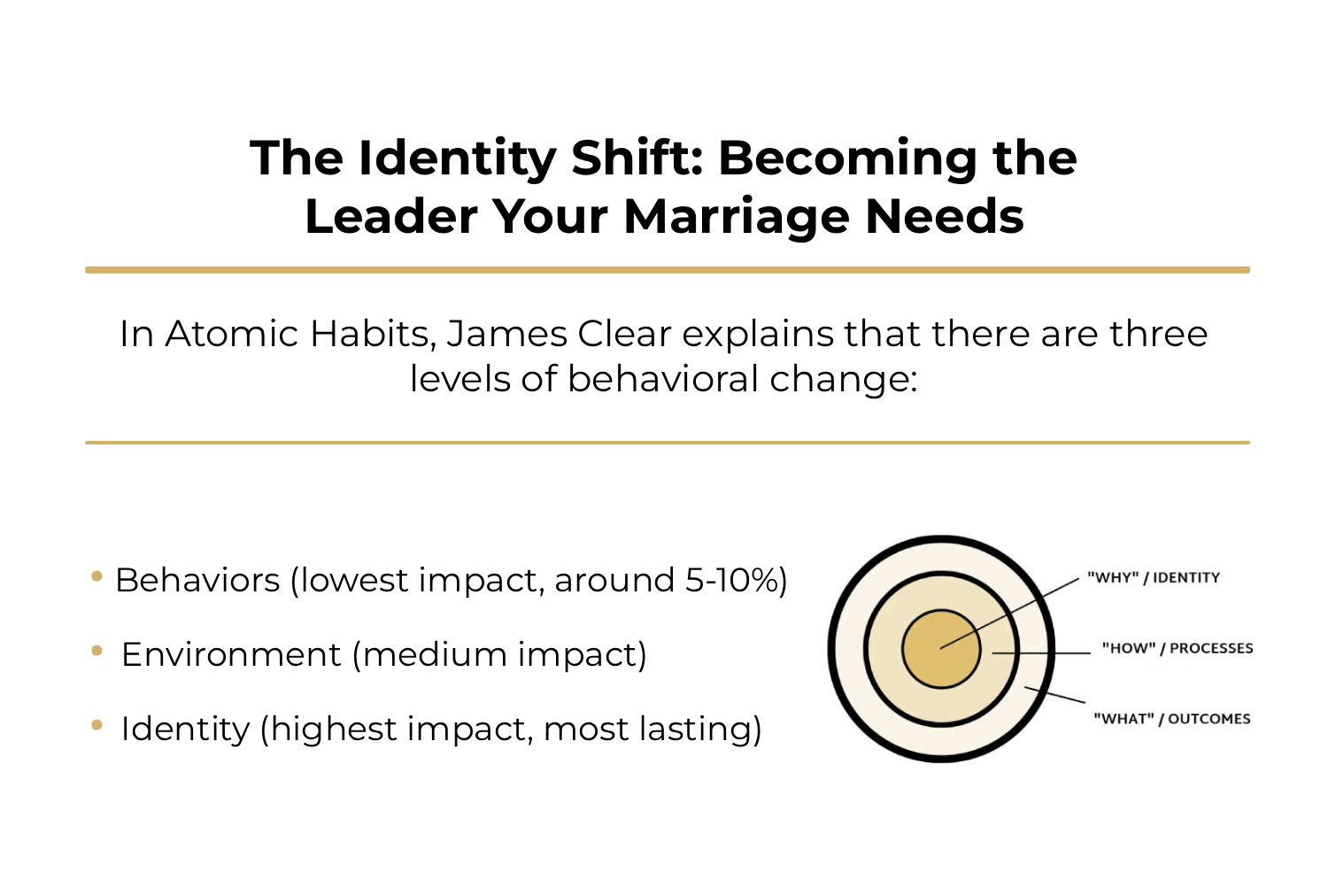
In Atomic Habits, James Clear explains that there are three levels of behavioral change:
- Behaviors (lowest impact, around 5-10%)
- Environment (medium impact)
- Identity (highest impact, most lasting)
Most men try to change at the behavior level. They try to do leadership things- make more decisions, be less reactive- but they haven’t adopted the identity of a leader yet. So it feels forced. It doesn’t stick.
Here’s what changes everything: Instead of just doing leadership behaviors, start identifying as a leader.
Tell yourself:
- “I am the captain of my ship.”
- “I am a leader in my marriage.”
- “I am the master of my domain.”
When you internalize this identity, leading becomes natural. You stop second-guessing yourself. You make decisions from a place of confidence rather than fear. And that shift in how you see yourself changes how she experiences you.
–Josh Hudson, LMFT
FAQ
Q: What if my wife refuses to open up no matter what I do?
If you’re consistently showing up with non-reactive presence, creating safety, and leading with confidence, she will often start to soften over time. However, change doesn’t happen overnight, especially if years of emotional disconnection have built walls. Many men in our program report that it took 3 to 6 weeks of consistent shifts before their wives began responding differently. The key is focusing on what you can control rather than trying to force her response.
Q: My wife says she’s “just not happy” and doesn’t know why. How do I fix that?
“I’m just not happy” is usually code for “I don’t feel emotionally safe or connected to you.” It’s not about surface-level happiness from dates or gifts. It’s about the deeper emotional foundation. Focus on the three shifts in this article: respond instead of react, create safety, and provide structure. When she feels safe and led, happiness tends to follow naturally.
Q: Isn’t validating her emotions just letting her walk all over me?
No. Validation isn’t agreement. It’s acknowledgment. You can validate her feelings while maintaining your boundaries. For example: “You feel hurt because you wanted more support from me. I understand that. Here’s what I’m willing to do moving forward.” Validation creates connection. It doesn’t mean you have to give in to every request or take blame for everything.
Q: How long does it take to see results from these shifts?
Results vary based on how disconnected the relationship currently is and how consistently you implement these changes. Some men notice small shifts within days- less criticism, a softer tone. For others, especially in marriages with deep wounds or separations, it can take several weeks to months of consistent effort. The key is showing up differently every day, not looking for immediate validation from her responses.
Next Steps
Results vary based on individual effort, relationship context, and consistency of application. Marriage Reset provides coaching and frameworks, but outcomes depend on your implementation and unique situation. We never guarantee specific results.
If your wife is emotionally withdrawn and you’re tired of feeling confused about what to do, you might benefit from structured guidance. A Marriage Evaluation Call gives you the chance to discuss your specific situation with someone who understands the dynamics at play and can help you map out what you can control next.
On that call, you’ll review where things stand, what patterns might be keeping you stuck, and what a clear path forward could look like using the ERM Method that has helped hundreds of men reconnect with their wives. This isn’t a high-pressure sales call. It’s a conversation about your marriage and whether coaching makes sense for your situation.
If you want to see whether this approach could work for you, book a Marriage Evaluation Call. You’ll get clarity on your next steps either way.
DISCOVER THE 5 STEPS TO SAVING YOUR MARRIAGE
Even If Your Wife Already Filed For Divorce


