


Why Your Wife Keeps Bringing Up The Past (And Won't Let Go)
You’ve apologized. You’ve changed. You’re doing everything differently. And still, out of nowhere, she brings it up again. That thing from three years ago. Or five.
Sometimes she even says things you know aren’t true:
“I never loved you,” “the sex was always bad,” “I’ve been unhappy for years.”
It feels like she’s handcrafting words designed to break you down. You just want to shake her and ask:
“Don’t you want to be happy? I love you so much. Why can’t you let go?”
Here’s what’s actually happening, and more importantly, what you can do about it.
Why Does My Wife Keep Bringing Up The Past?
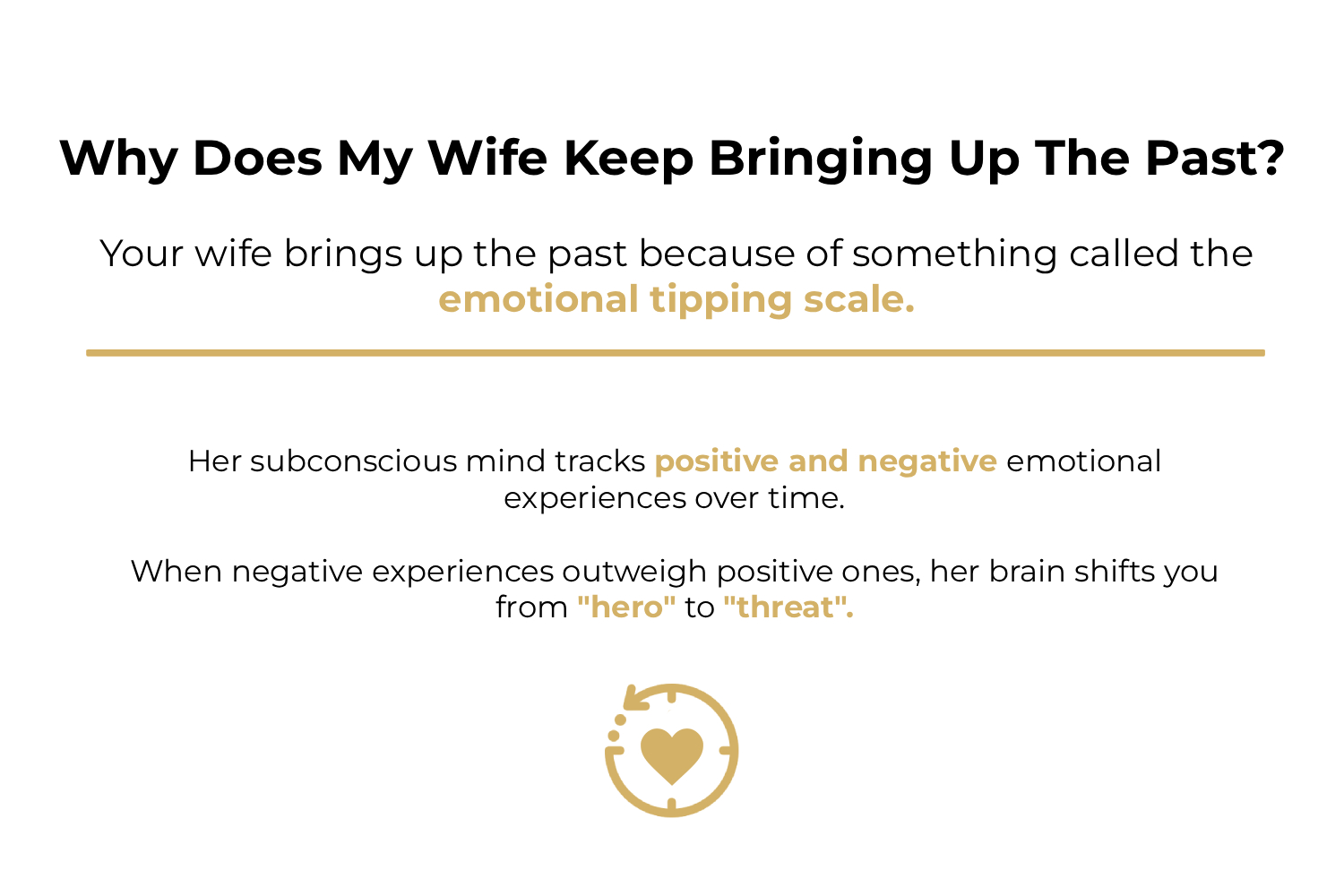
Your wife brings up the past because of something called the Emotional Tipping Scale.
Her subconscious mind tracks positive and negative emotional experiences over time. When negative experiences outweigh positive ones, her brain shifts you from “hero” to “threat,” and this changes how she remembers your entire relationship history.
Think of her subconscious as a record keeper. In the beginning, your relationship had a strong ratio of positive to negative experiences. Maybe 5:1 or even 7:1. The wedding. Falling in love. The first time you were intimate. All the dates and moments that made her feel safe, excited, and connected.
But over time, life happened. Kids arrived. Work stress piled up. Maybe there was a death in the family or financial pressure. The ratio started to shift. 5:1 became 3:1. Then 2:1. Then 1:1. And eventually, the tipping point occurred.
Once that scale tips negative, she stops seeing you as her hero and starts seeing you as a threat. This is not conscious. She’s not sitting down with a spreadsheet calculating your failures. Her brain is doing this automatically, based on how she feels about you right now.
Here’s what makes this confusing: she still has what I call a “dual mind narrative” with you.
She might plan a trip with you one week, then tell you she wants a divorce the next. She might work on the house with you, run a business with you, but also say “I’m not in love with you anymore.” This isn’t manipulation. It’s the tipping scale in action.
Why Your Wife Is “Rewriting History” (And Why You Need to Stop Believing Her)
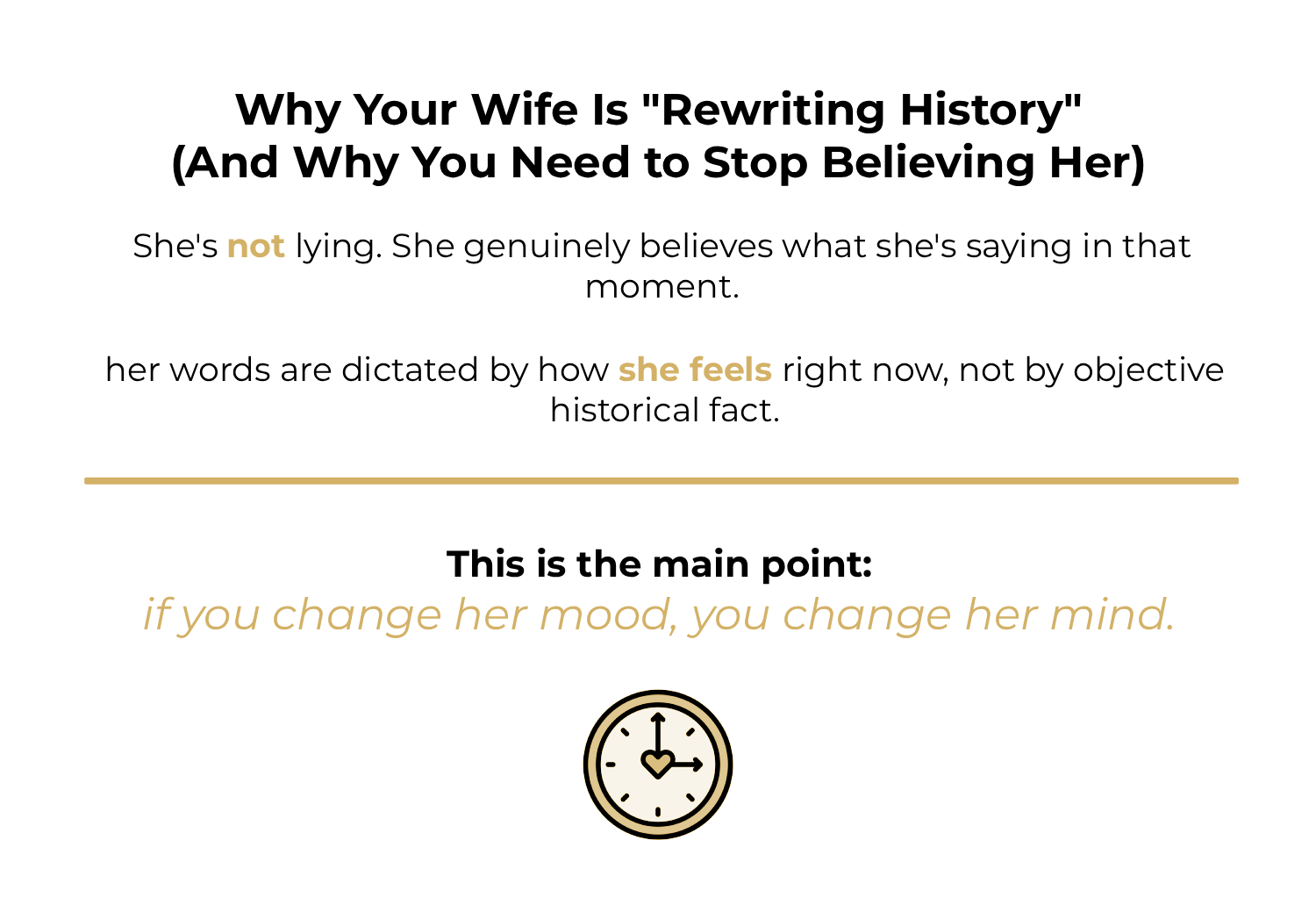
She’s not lying. She genuinely believes what she’s saying in that moment.
When a wife says “I haven’t loved you for 10 years,” or “the sex was never good,” or “I’m only here for the kids,” you need to understand something critical: her words are dictated by how she feels right now, not by objective historical fact.
In the feminine emotional framework, current feelings filter past memories. When she feels negatively toward you in the present, her brain reinterprets neutral or even positive past memories as negative. That beautiful wedding you remember? To her right now, it might just feel like “a good time” with no emotion attached. Those romantic dates you took her on? She might genuinely not remember them, or remember them as obligatory.
This is the main point: if you change her mood, you change her mind.
The biggest mistake men make when their wife says these things is believing them as permanent truth. You hear “I never loved you” and think, “Oh my God, she’s been lying to me for years. It’s over.”
No. She believes it right now because of how she feels right now. But feelings shift. Memory shifts with them.
There are two selves within her. The first is her authentic self, the woman who fell in love with you, who wanted to build a life with you.
The second is what I call the protector. This protector developed usually early in life, often from childhood trauma or difficult relationships. It’s her hyper-independent, defensive, cold and masculine side that keeps her emotionally safe.
Right now, the protector is in control. She has to protect herself because you’ve become a threat to her. You’re the bodyguard who turned the gun on her. And until you become safe again, that protector isn’t going anywhere.
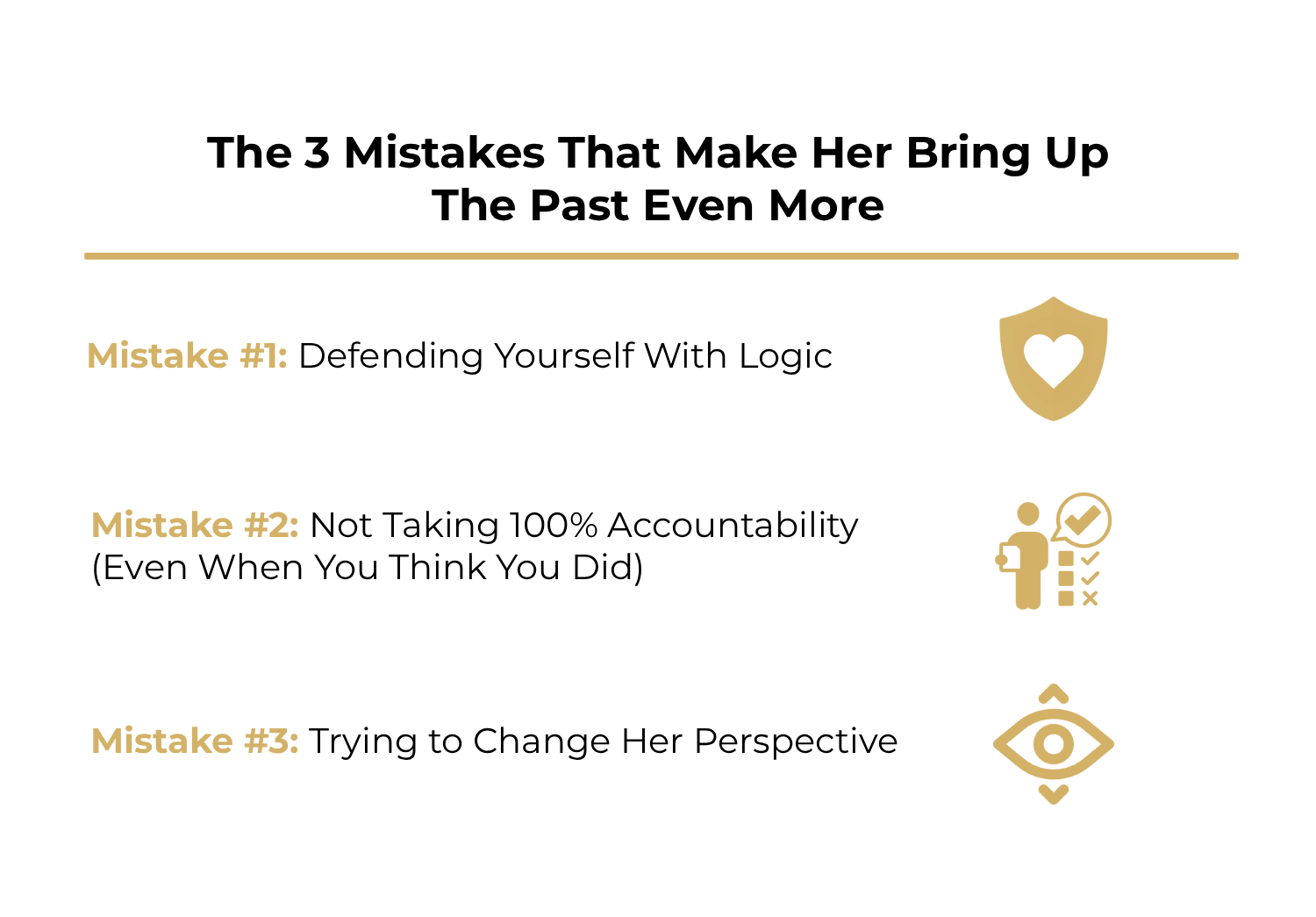
The 3 Mistakes That Make Her Bring Up The Past Even More
Most men unknowingly make things worse when their wife brings up the past. Here are the three most common mistakes.
Mistake #1: Defending Yourself With Logic
Your logical framework solves almost every problem in your life except this one. When she says “You never took me on enough dates,” your brain immediately goes to defense mode.
“Wait, we went to that restaurant. And remember that concert? And the beach trip? I took you on tons of dates!”
This logical defense mechanism makes things worse. Using logic to fix an emotional problem is counterintuitive. She doesn’t need a courtroom defense. She needs emotional validation and safety.
When you defend, you’re telling her that her feelings are wrong, which only confirms that you’re still not safe.
Mistake #2: Not Taking 100% Accountability (Even When You Think You Did)
This mistake is more subtle than straight-up defensiveness, but it’s just as damaging.
Most men think they’re taking accountability when they say: “I’m sorry those words hurt you.”
But she can sense the displacement of ownership in that sentence. You’re saying the words hurt her, not that you hurt her. You’re putting the blame outside yourself.
The correct language is: “I’m sorry I hurt you when I said that.”
This matters more than you think. She won’t forgive until you take full ownership in your language. Whether you intended to hurt her or not is irrelevant. In her reality, you did hurt her. Honor that reality. Take full ownership. Say it like you mean it, because you cannot fake this.
Mistake #3: Trying to Change Her Perspective
Let me give you a personal example. My partner and I were having a great day. We went to the park, got coffee, everything was perfect.
Later, I was in the shower, stressed about some business issues. She turned off the lights and took my towel as a joke.
Normally I’d laugh. But in that moment, stressed and caught off guard, I said: “I just want a woman who’s actually going to give me my towel and not take it away.”
My intention was to express that I wanted her to be that woman. But she heard: “I want a different woman.” She got upset.
And in that moment, my ego kicked in. I wanted to explain what I really meant. I wanted to change her perspective, to make her see that she misunderstood me. But here’s the fact: those words hurt her. It doesn’t matter what I meant. It matters what she experienced.
You can’t argue someone out of their feelings. When she’s upset, there’s a storm brewing inside her. You’re standing in that storm saying “Hey, there’s a button here. If you just press it, the storm will stop.” But she doesn’t see the button. And even if she did, she doesn’t care.
Your job is not to explain the button. Your job is to help dissipate the storm.
What’s Really Happening When She Brings Up The Past
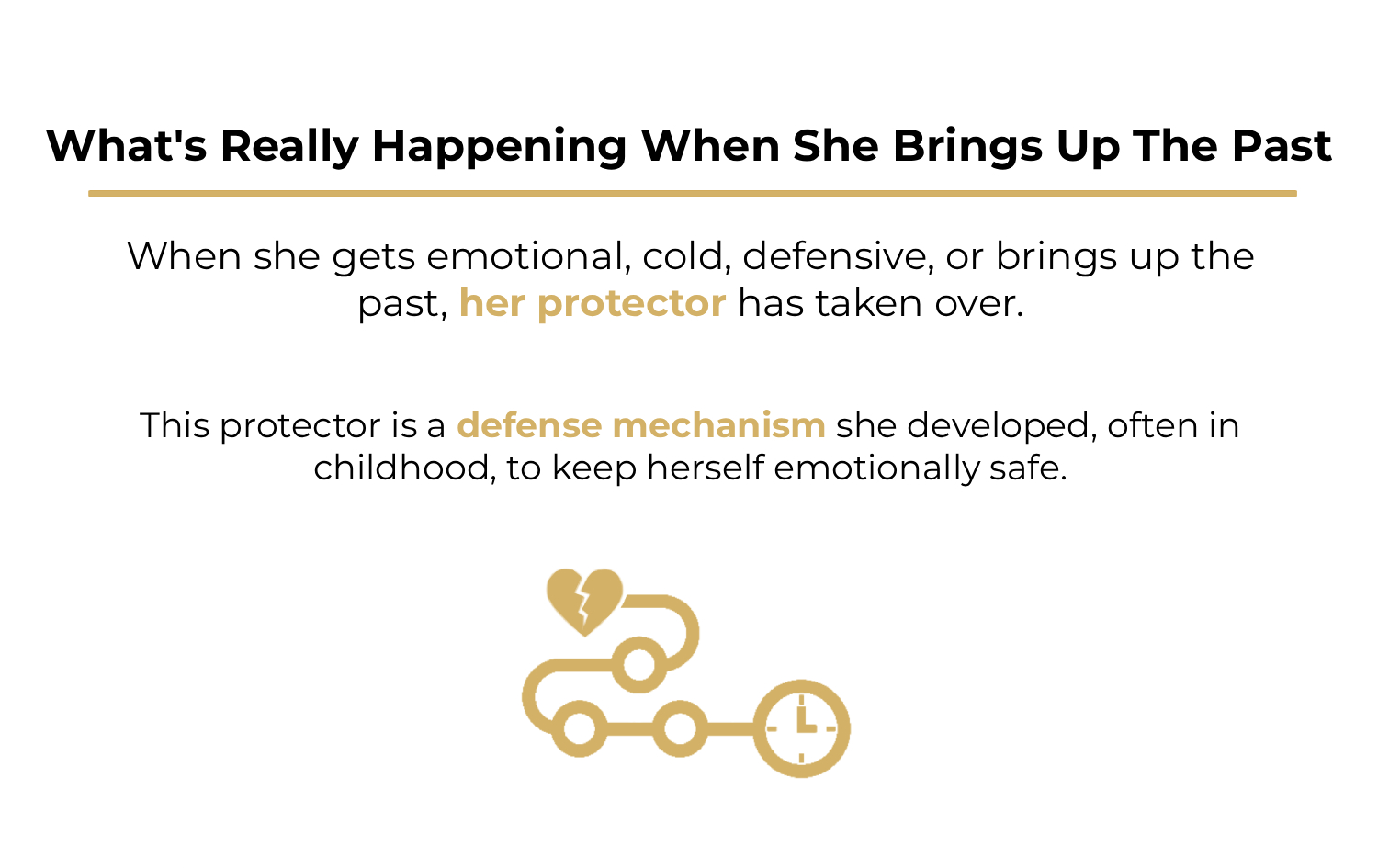
When she gets emotional, cold, defensive, or brings up the past, her protector has taken over.
This protector is a defense mechanism she developed, often in childhood, to keep herself emotionally safe. Maybe she grew up in a difficult environment. Maybe she learned early that vulnerability meant danger. So she built this hyper-independent, defensive side to survive.
But underneath that protector is a scared, hurt little girl who just wants to be loved. Just like underneath your defensiveness and intellectualizing is a scared little boy who wants to be loved.
When she says harsh things, when she brings up old wounds, when she rewrites history, she’s not trying to hurt you. She’s trying to keep herself safe. Her words aren’t weapons. They’re shields.
You’ve become the villain in her story because the emotional tipping scale shifted. She doesn’t trust that you can support and care for her. So the protector stays up front, pushing you away, keeping you at a distance.
Your job is to become safe again. And that starts with how you respond when she’s in protector mode.
How to Get Your Wife to Actually Let Go of The Past
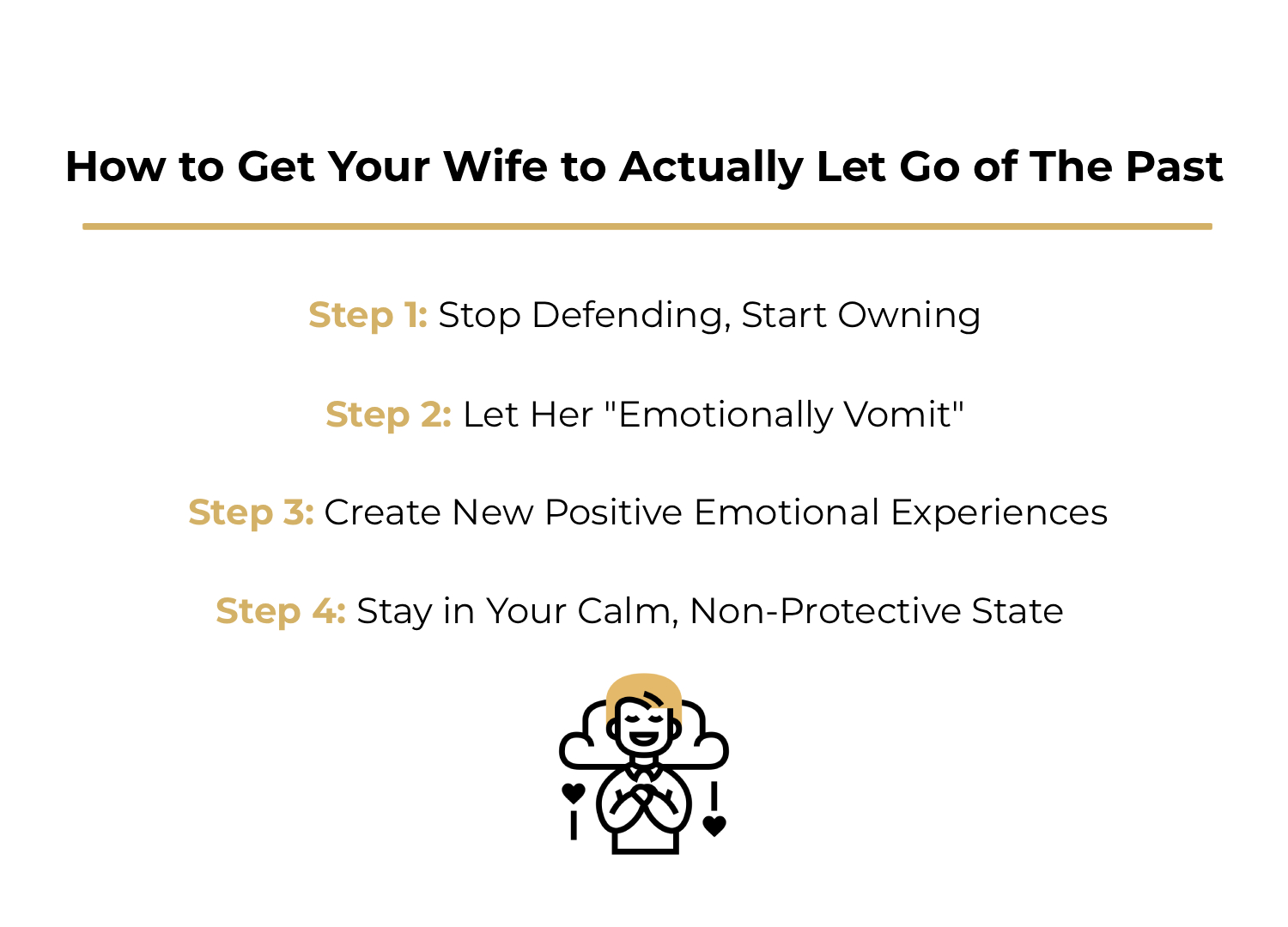
Here’s the framework that tends to work when applied consistently. This isn’t a quick fix. It requires weeks, sometimes months, of showing up differently. But hundreds of men in our coaching program have used this approach to shift their wife’s emotional state and rebuild trust.
Step 1: Stop Defending, Start Owning
The next time she brings up the past, look her in the eyes and say: “I’m sorry I hurt you.”
Not “I’m sorry those words hurt you.” Not “I’m sorry you felt that way.” Just: “I’m sorry I hurt you.”
Mean it. She will know if you’re faking. This is not a technique. This is genuine ownership of the impact your actions had on her, regardless of your intentions.
Step 2: Let Her “Emotionally Vomit”
She needs to release the emotional poison that’s been building up. Each time she brings up the past, she’s trying to process pain that hasn’t been fully acknowledged.
When you defend yourself, when you explain, when you minimize, you’re taking that emotional vomit and throwing it back at her. Instead, be the storm shelter. Let her release it. Stay calm. Stay present. Don’t make it about you.
This may take weeks. She might bring up the same thing five times, ten times, twenty times. Each time, you respond the same way: with ownership, with calm, with presence. Over time, the need to bring it up naturally decreases because the emotional charge behind it dissipates.
Step 3: Create New Positive Emotional Experiences
Taking ownership and letting her vent is necessary, but it’s not sufficient. You must actively shift the emotional tipping scale back by creating new positive experiences.
These are what I call potency actions. They’re specific behaviors that build trust, create attraction, and establish emotional safety. This isn’t about grand gestures or expensive gifts. It’s about consistent, daily actions that meet her emotional needs.
This means:
- Following through on what you say you’ll do
- Being emotionally present when she talks to you
- Leading with calm confidence instead of reactivity
- Creating moments of connection without agenda
- Showing her through your behavior that you’re safe again
Step 4: Stay in Your Calm, Non-Protective State
Be the man who doesn’t get defensive when she’s upset. Lean in when she pushes away. Stay vulnerable instead of intellectualizing or retreating into logic.
Your calm leadership is what allows her protector to retreat. When you stay grounded, when you don’t match her emotional intensity, when you take ownership without falling apart, you’re proving that you’re safe. You’re showing her that the bodyguard has put down the gun.
This is masculine leadership. Not dominance. Not control. Calm, consistent, emotionally intelligent presence.
FAQ
How long does it take for her to stop bringing up the past?
It varies with every relationship, but many men in our coaching program report noticeable shifts within three to eight weeks of consistent application. The key is that each time she brings it up, you respond differently than before. You’re not defending or explaining. You’re taking ownership and creating new positive experiences. Over time, the emotional scale tips back, and her need to bring up the past naturally decreases.
What if she’s changing facts about our history, like saying she never loved me?
She genuinely believes this in the moment because her current negative feelings are filtering how she remembers the past. This is the emotional tipping scale at work. When someone feels negatively toward you now, their brain reinterprets neutral or even positive past memories as negative. The solution isn’t to argue about what “really happened.” It’s to change how she feels about you in the present, which will change how she remembers the past.
I’ve apologized a hundred times. Why doesn’t she accept it?
Most apologies fail because they’re either defensive or followed by explanation. She can sense when you’re not taking full ownership. Additionally, apologies alone don’t shift the emotional tipping scale. You need to combine genuine accountability with consistent positive emotional experiences to rebuild trust. That’s what creates lasting change.
What if I don’t think I did anything that bad to deserve this treatment?
This is where most men get stuck. Whether you think the past mistake was “that bad” is irrelevant to her emotional experience. In her reality, she was hurt. Until you honor that reality and take full ownership without minimizing, explaining, or defending, she’ll keep bringing it up. This isn’t about being right. It’s about what works to save your marriage.
Take the Next Step
When your wife keeps bringing up the past, she’s not trying to punish you. She’s not being unreasonably stubborn. Her emotional record-keeping system has tipped negative, and now she sees your entire history through that lens.
The way forward isn’t more apologies, more explanations, or more logic. It’s taking full ownership in your language, letting her release the emotional poison without defending, and creating new positive emotional experiences that shift the scale back.
This takes time. It may take weeks of consistency. But each time you show up differently, calm, non-defensive, fully accountable, you’re proving you’re safe again. You’re allowing her protector to retreat and her authentic self to emerge.
Results vary based on individual effort, relationship context, and consistency of application. Marriage Reset provides coaching and frameworks. Outcomes depend on your implementation and unique situation. We never guarantee specific results.
If you want structured coaching and a clear roadmap for what to do next, consider booking a Marriage Evaluation Call. On that call, we’ll review your specific situation, identify what’s keeping you stuck, and map out the actions you can control to start shifting things. No pressure, no games. Just honest guidance on whether this approach could work for your marriage.
DISCOVER THE 5 STEPS TO SAVING YOUR MARRIAGE
Even If Your Wife Already Filed For Divorce


