


When Your Wife Says It's Over
When your wife says “I’m done,” “I’m no longer in love with you,” or “there’s no chance,” most husbands make one critical mistake. They believe her completely and respond from that devastated place.
You felt the coldness in her eyes. You heard the finality in her voice. It felt real because it was real in that moment.
But here’s what most men miss: the mistake wasn’t her words. The mistake was how you responded and what you did next.
Adam made the same mistake initially. His wife moved out. She was staying at her parents’ house. The situation looked finished. But four weeks later, she moved back in. Three weeks after that, they went on a surprise trip together. The connection came back stronger than it had been in years.
What changed? Not her. Him.
The three mental habits Adam used are what turned everything around. These aren’t communication techniques or behavioral tips. They’re internal shifts that tend to change how you show up, which naturally changes how she experiences you.
When Your Wife Says It’s Over: Understanding the Real Tipping Point
Most men assume their wife reached this point because of one big event. A betrayal. A fight that went too far. Something specific they can point to.
But for the majority of marriages that hit this crisis, it’s not one moment. It’s what relationship researchers call death by a thousand cuts.
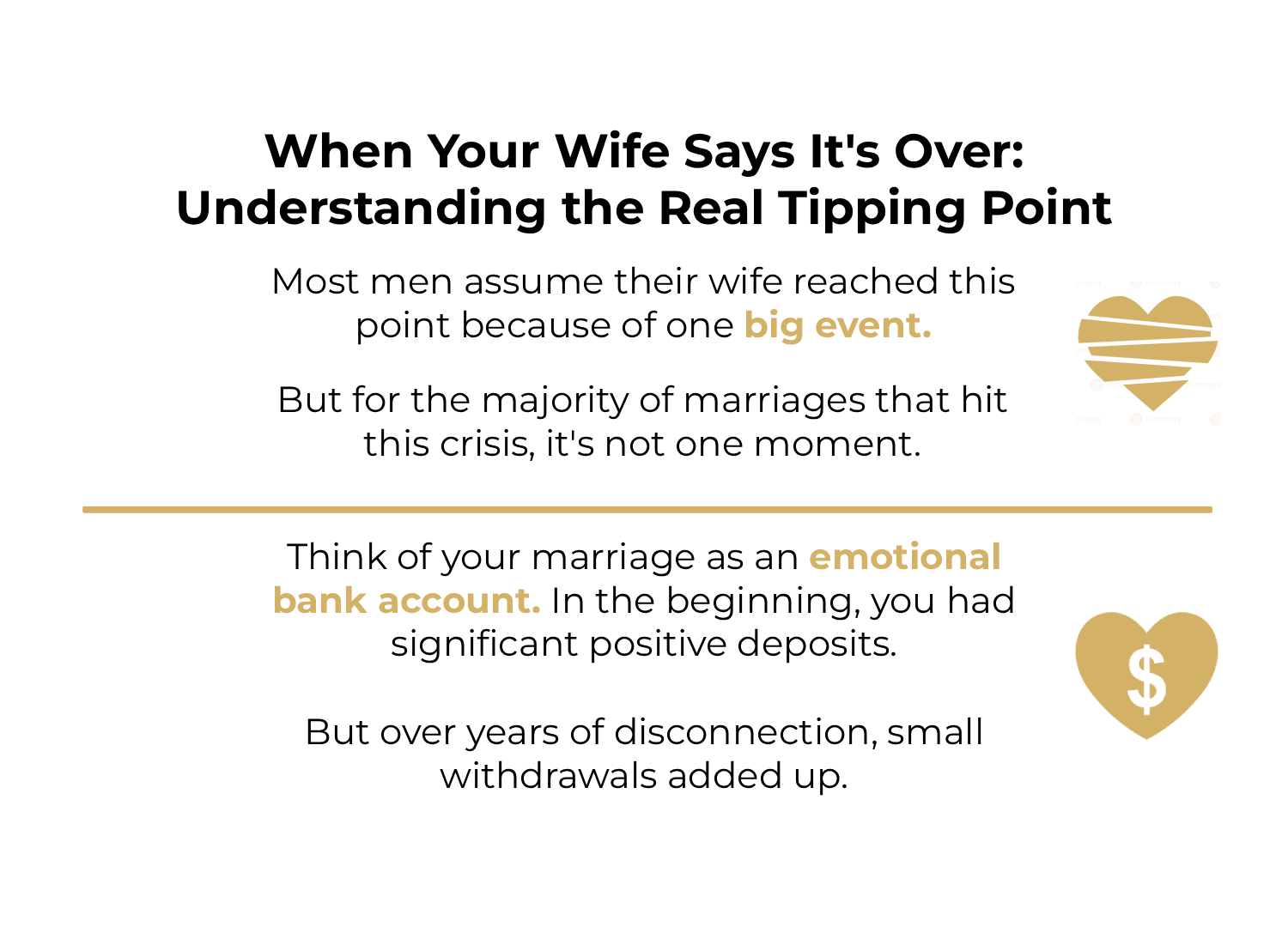
Think of your marriage as an emotional bank account. In the beginning, you had significant positive deposits. Connection. Laughter. Feeling chosen. Being pursued.
But over years of disconnection, small withdrawals added up. Every time you were complacent. Every time you didn’t lead. Every time you became emotionally reactive or shut down. Each instance was a small negative withdrawal on that emotional scale.
Eventually, one moment broke the camel’s back. That’s when you heard “I’m done.”
Research on successful marriages shows they maintain a ratio of about 5 positive emotional experiences to every 1 negative interaction. When that ratio drops to 2:1 or even 1:1, a tipping point occurs. You shift from being the hero in her story to being the villain.
Here’s the mistake most men make after hearing those words: They try to make deposits through external actions—gifts, dates, apologies, grand gestures—while the internal pattern that created the withdrawals remains unchanged. She can sense the same person beneath the actions. The same patterns. The same reactivity.
That’s why those attempts often backfire and push her further away.
The 3 Mental Habits That Often Turn Everything Around
These habits aren’t about what you say or what you do externally. They’re about shifting who you are internally, which naturally changes everything else.
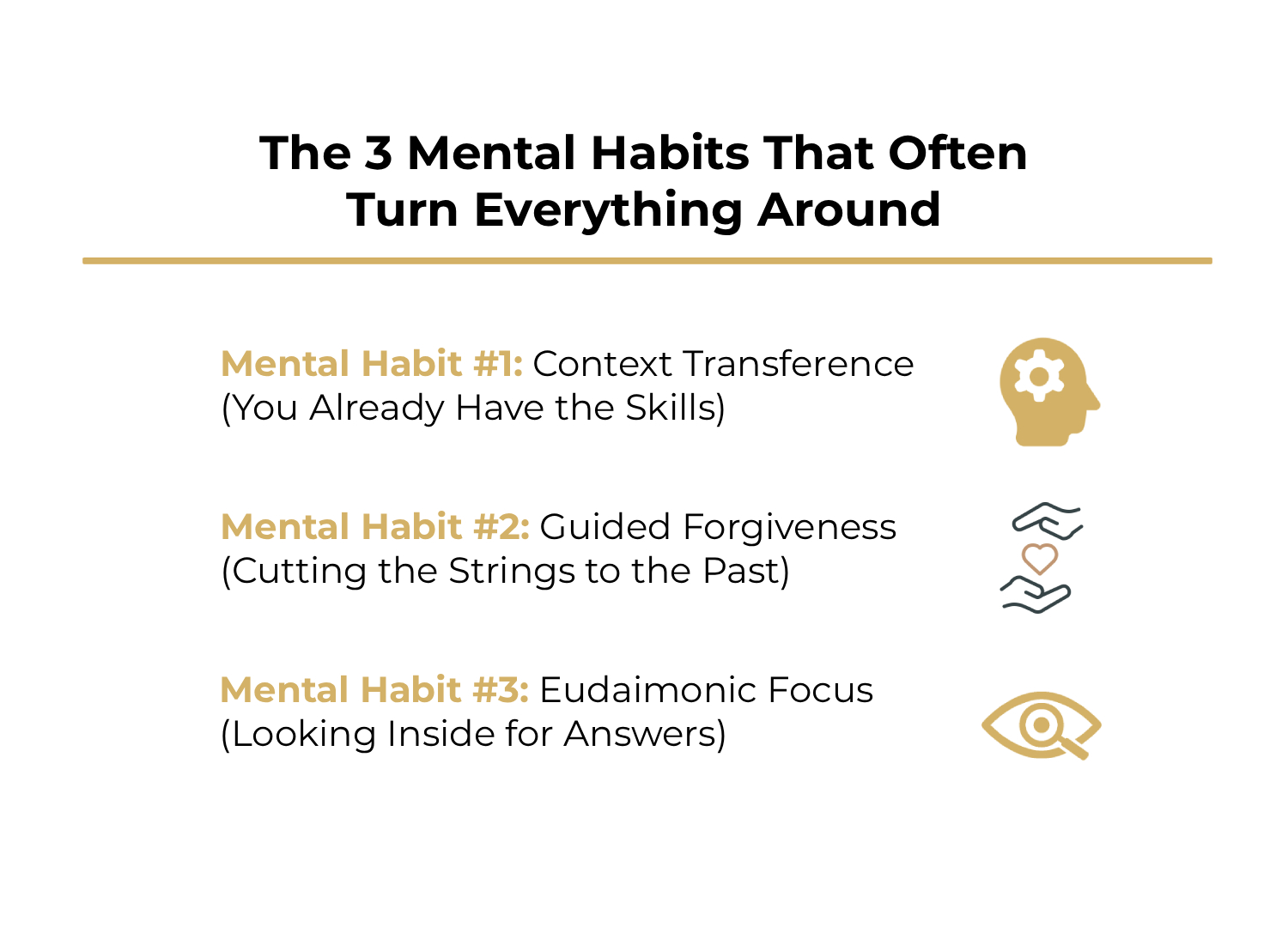
Mental Habit #1: Context Transference (You Already Have the Skills)
Here’s something you need to hear: you don’t need to learn anything new.
That might sound strange, but it’s true. The skills you need to turn this around already exist in your psychological makeup. You just haven’t been applying them to your marriage.
Many husbands tell us: “At work with my employees, I’m confident, calm, and unreactive. I listen well. If I could be that way with my wife, I wouldn’t be here.”
Sound familiar?
What context transference means: It’s the ability to take skills you already possess in one area of life and apply them to your marriage.
When you put your wife on a pedestal or romanticize the relationship too much, you freeze up. You stop being your authentic, capable self. You become reactive, defensive, or withdrawn. None of which are how you naturally operate in contexts where you feel confident.
Think about it this way. At work, you probably handle criticism without becoming defensive. You probably lead meetings without needing validation. You probably set boundaries without feeling guilty.
But at home? Different story.
Why this happens: You’ve attached too much meaning to her opinion of you. You’ve made her approval the measure of your worth. So when she’s distant or critical, you can’t access your grounded self. You become the anxious, reactive version instead.
How to implement this:
- Identify the version of yourself where you’re most grounded. Maybe it’s at work. Maybe it’s with certain friends. Maybe it’s coaching your kid’s team.
- Notice how you feel in that context. The calm. The confidence. The clarity.
- Practice accessing that same presence with your wife, especially during neutral moments first.
This isn’t about performing or pretending. It’s about removing the layer of anxiety and insecurity that prevents you from being your actual self around her.
Mental Habit #2: Guided Forgiveness (Cutting the Strings to the Past)
Most men think they know what forgiveness means. They say “I’m sorry” and think they’ve handled it.
But here’s what we’ve found after thousands of hours working with husbands: there’s often still a tone of resentment underneath. A scorekeeping mindset. A feeling that she owes you something because of what you’ve tried or what you’ve put up with.
True forgiveness goes deeper.
The metaphor that makes this clear: Imagine strings attached to the back of your head, pulling you toward every past hurt, disappointment, and fight. Every new interaction pulls those strings, dragging you back into old patterns and emotions.
When you’re focused on the past, you replicate past scenarios. You bring old resentments into new conversations. You hear criticism that isn’t there because that’s what you’ve learned to expect.
Forgiveness is the scissors that cuts those strings, allowing you to move forward into a new future with your wife.
The deeper issue we see constantly: Through working with hundreds of men, we’ve found most husbands carry one underlying belief: “Deep down, I don’t deserve my wife’s love.”
Until you address this subconscious voice, external changes won’t stick. That voice will find subtle ways to sabotage everything. You’ll self-sabotage. You’ll pick fights. You’ll prove yourself right.
How to implement guided forgiveness:
True forgiveness means apologizing to yourself for the part of you that believed you had to act in ways that damaged the relationship. It’s not about her forgiving you. It’s about releasing the internal narrative that keeps you stuck.
Forgive yourself for:
- Not knowing better at the time
- Operating from fear instead of clarity
- Tolerating disconnection instead of addressing it
- Making her responsible for your emotional state
When you cut those strings to the past, you can show up differently today. She feels the difference even if she can’t name it.
Mental Habit #3: Eudaimonic Focus (Looking Inside for Answers)
Eudaimonia means human flourishing. The opposite is hedonism—seeking immediate pleasure and avoiding pain.
This mental habit is about focusing on internal growth rather than external blame or external fixes.
Here’s a story that explains this perfectly:
Imagine you lost your keys inside your house in the dark. The lights went out, and you can’t find them. You’re searching everywhere, getting frustrated, running late for a date with your wife.
Then you see a streetlight outside. You think, “At least there’s light out there,” so you go outside and start looking for your keys under the streetlight.
Someone walks by and asks what you’re doing. You explain you lost your keys. They help you search. After a while, they ask, “Where did you lose them?”
You say, “Inside the house.”
They look at you confused. “Then why are you looking out here?”
You reply, “Because it’s dark inside. At least there’s light here.”
That’s what most men do in their marriage crisis.
They look for answers outside themselves because it’s easier. It feels productive. There’s something to point at.
The external blame trap sounds like:
- “If my wife wasn’t so critical…”
- “If her therapist wasn’t influencing her…”
- “If she didn’t have trauma from her childhood…”
- “If her family would stop interfering…”
These might be real factors. But focusing on them keeps you powerless. You’re looking for keys under the streetlight while the answers are inside the house—inside you.
What this looks like in practice:
One client said: “Pretend I just met her. Amplify everything inside of her. Allow that to be me. Forget everything else. If I make her better, she’ll make me better.”
This isn’t about controlling her or making her change. It’s about recognizing that your internal transformation often creates the conditions for external change.
When you stop blaming and start focusing on what you can control—your reactivity, your emotional state, your consistency—you often find that she responds differently. Because you became someone different to be around.
Common Mistakes to Avoid After She Says It’s Over
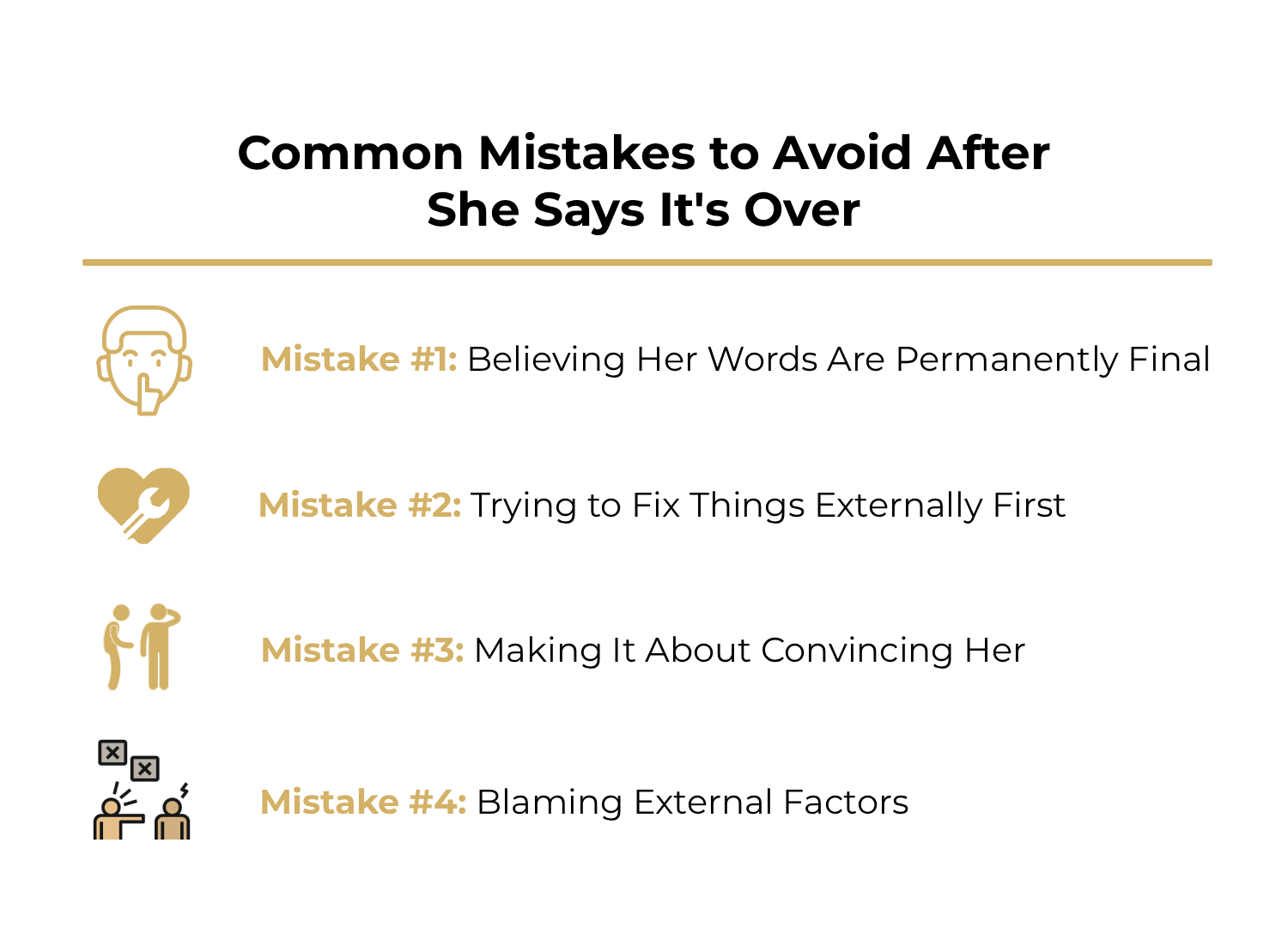
Mistake #1: Believing Her Words Are Permanently Final
When she says “I’m done” or “I don’t love you anymore,” she’s expressing how she feels right now based on the emotional deficit in the relationship. This isn’t necessarily permanent, but responding from desperation tends to confirm her feelings.
The coldness you see is often a protection mechanism after years of disconnection. When you make genuine internal shifts—not performed changes—that often changes how she experiences you.
Mistake #2: Trying to Fix Things Externally First
Gifts. Dates. Grand gestures. Intensive conversations about the relationship.
These often backfire when the internal patterns haven’t changed. She can sense the same person beneath the actions. The same neediness. The same reactivity. The same emotional patterns.
Mistake #3: Making It About Convincing Her
This isn’t about persuasion or negotiation. When you try to convince her to give you another chance, you’re operating from a place of not deserving it. The three mental habits above address your internal position first. When that shifts, convincing becomes unnecessary.
Mistake #4: Blaming External Factors
Her family. Her therapist. Her past trauma. Her mental health. These might be real factors, but focusing on them keeps you powerless. Focus on what you can control: your internal state and how you show up.
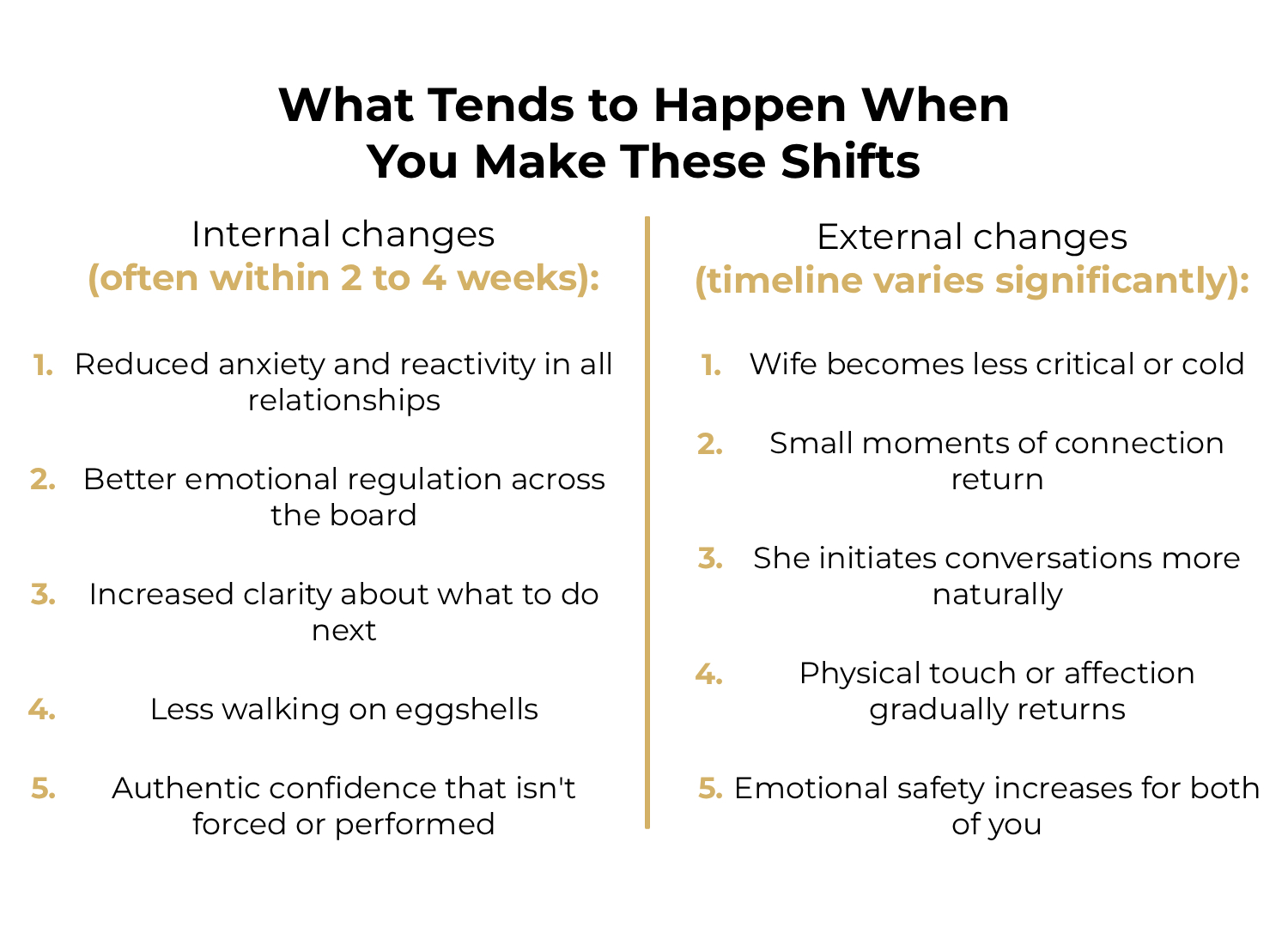
What Tends to Happen When You Make These Shifts
Based on working with hundreds of men in similar situations, here’s what often occurs when these mental habits are implemented consistently.
Internal changes (often within 2 to 4 weeks):
- Reduced anxiety and reactivity in all relationships
- Better emotional regulation across the board
- Increased clarity about what to do next
- Less walking on eggshells
- Authentic confidence that isn’t forced or performed
One client quit biting his nails after doing it his entire life. Another quit drinking without trying. Another stopped needing constant reassurance from friends.
These weren’t the goals. They were byproducts of the internal shifts.
External changes (timeline varies significantly):
- Wife becomes less critical or cold
- Small moments of connection return
- She initiates conversations more naturally
- Physical touch or affection gradually returns
- Emotional safety increases for both of you
In Adam’s case, his wife moved back in after three weeks. A few days later, she surprised him with a gift—a weekend trip to New York. The intimacy came back. The emotional connection returned stronger than before.
Important note: Results vary based on your specific situation, your consistency with implementation, and numerous other factors. These aren’t guarantees. They’re patterns we’ve seen work for many men who were willing to do the internal work.
FAQ
What if she really meant it? The coldness in her eyes was real.
She likely does mean it right now, based on the emotional state of the marriage. But “right now” isn’t permanent. The coldness is often a protection mechanism after years of disconnection. When you make genuine internal shifts, not performed changes but real transformation, that often changes how she experiences you. We’ve worked with hundreds of men whose wives had that same cold, final tone. Many of those marriages turned around.
I’ve tried everything—therapy, books, YouTube videos. Why would this be different?
Most resources focus on communication techniques or understanding psychology. Those can help, but they don’t address the internal patterns that keep you stuck. The three mental habits above are about rewiring how you show up, which tends to change the dynamic naturally. This is also coaching, not therapy. We focus on what to do next, not just understanding what went wrong.
What if my wife won’t participate or agree to work on things?
The approach we teach doesn’t require her participation initially. These mental habits are internal shifts you make regardless of her current position. In fact, many men find that when they stop trying to get her to “work on the marriage” and focus on their own transformation, she often becomes more open over time.
How long does this typically take?
Every situation is different. In the case above, Adam saw his wife move back in after three weeks, with full reconnection by week four. Some men see shifts in days, others take months. The timeline depends on how deep the disconnection is, how consistently you implement these habits, and many individual factors. What matters is that you’re making real progress, not that it happens on a specific timeline.
The Path Forward
When your wife says it’s over, the natural response is devastation and panic. But the mistake isn’t her words. It’s responding from that place of desperation, which tends to confirm everything she’s feeling.
The three mental habits—context transference, guided forgiveness, and eudaimonic focus—are about making internal shifts that naturally change how you show up. You’re not trying to convince her or perform changes. You’re addressing the core patterns that created the disconnection in the first place.
This approach has worked for hundreds of men who were in your exact position or worse. Men whose wives had moved out, filed for divorce, or were involved with someone else. It’s not about guarantees or manipulation. It’s about genuine transformation that tends to create the space for reconnection.
The question is: are you ready to look inside for the answers instead of searching under the streetlight?
If you want structured coaching and clear next steps tailored to your specific situation, consider booking a Marriage Evaluation Call. During this call, we’ll review where you are, what you can control next, and whether our approach is right for you. This isn’t a high pressure sales conversation. It’s a strategy session to assess your situation and determine the best path forward. Book your call to discuss your options and what comes next.
DISCOVER THE 5 STEPS TO SAVING YOUR MARRIAGE
Even If Your Wife Already Filed For Divorce


