


3 Principles That Transform a Broken Marriage
Picture this: your wife posting on Facebook in front of everyone she knows, saying you loved her through the darkest time in your marriage. That you carried her when she couldn’t carry herself. That you showed her what unconditional love truly means.
After months or years of feeling like you’re failing at the one thing that matters most, that probably sounds impossible.
But that’s exactly what one man in our community experienced. And the difference between him and the men who stay stuck in the painful cycle isn’t more effort. You’ve probably already tried harder than most.
The difference comes down to three specific principles.
When Everything You’ve Tried Hasn’t Worked
You’ve read the books. Watched the videos. Maybe even tried therapy or date nights. You’ve made temporary improvements, shown her you’re working on things, and then somehow slipped back into old patterns. Each time, she loses a bit more trust.
One man who joined our program described it perfectly. After 38 years of marriage, successful in nearly every area of life as an entrepreneur, real estate investor, and business owner, he wrote:
“My marriage has been mostly sexless and it has been the one great failure of my life. I failed her.”
Here’s what he realized:
“Maybe one of the reasons I’ve been able to accomplish so much in my life is because I’ve used all that activity to hide from what’s most important to me.”
When a man who solves complex problems at the highest level can’t fix his own marriage, the issue isn’t intelligence or effort. He was approaching his marriage like a business problem when it requires something completely different.
These three principles address the actual root causes that keep men stuck. Each one targets a specific pattern that quietly kills marriages, even when both people still love each other.
Principle 1: Extreme Ownership (Focus Only on What You Control)
The first principle separates men who transform their marriages from those who stay stuck: taking complete ownership of your part without focusing on her faults, her trauma, or what she’s done to you.
This doesn’t mean you’re the villain or she’s perfect. You’re recognizing that trying to change her, fix her, or wait for her to change is a losing strategy.
You can’t control whether she has bipolar disorder, how her past trauma affects her, whether she goes to therapy, or how she responds to you. But you can control yourself.
Why This Matters More Than You Think
When you focus on things outside your control, you can’t measure progress. You set goals you can’t achieve. You feel defeated when she doesn’t change despite your efforts.
But when you put all your energy toward things within your control, something shifts. You start achieving goals. That builds positive momentum. Your internal self-worth increases. And that’s when you naturally start doing the things you’ve been trying to force: setting boundaries, being less needy, letting go of control.
Your ego resists this because taking ownership means you have to change. If you blame her, you can stay comfortable. But comfort is what got you here.
The Ego’s Defense Mechanism
Here’s why this is so hard: your ego wants to protect you from the pain of admitting you need to change. When something threatening happens, it’s easier to say “I had no control over this” than to accept responsibility.
If you had control, that means you have to do the hard work. You have to go to the gym instead of sitting on the couch. You have to examine your patterns instead of avoiding them. You have to meditate, take cold showers, and do the uncomfortable things most men won’t do.
One man in our program had a powerful moment of ownership. He’d been sober for 60 days. His wife wanted to go on a trip with just the two of them, a huge win. But when she ordered drinks everywhere they went, he felt left out. He rationalized having one glass of wine.
Afterward, he posted:
“I fell back to blaming her because she was getting drinks everywhere we went. I tried to justify it. But I compromised my commitment. I need to own that and keep growing.”
He could have easily said “She was drinking, I had one glass after 60 days, that’s not fair.” Many men would.
Instead, he took ownership.
Your Action Step
Right now, write down your marriage goals. Everything you want to accomplish or change. Then circle only the ones completely within your control.
Those circled goals are the only ones worth pursuing right now. Focus there, measure your progress there, and build momentum there.
Principle 2: The Armored Heart (Moving from Logic to Presence)
Many successful men try to fix their marriage the same way they built their business: with logic, strategy, and systems. They search for the right conversation starters, the perfect words to say, the exact steps to follow.
But emotional connection doesn’t work that way.
The Lake Metaphor
Think of it like this: you and your wife are in a lake together. All your logic, planning, and calculated words stir up the dirt from the bottom. The water becomes murky. You can’t see each other clearly.
True connection happens when you stop stirring. When you let the dust settle. When the water becomes clear, you can actually see her for who she truly is.
One client asked: “I’m trying to find ways to spark conversations that foster better connection. What questions should I ask her before bed? What topics should we discuss?”
I could tell from his question he was trying to use logic to create emotional connection. He wanted a checklist. The right formula.
But if I gave him conversation starters, he’d be stuck in his head: “Okay, what do I say next? What’s the next question?” And she would feel him trying to get somewhere, trying to accomplish something.
Connection Is Not a Destination
Emotional connection happens when you’re not in your head, not following a script, not trying to get somewhere. You’re fully present with her without agenda or outcome.
This is especially hard for men who built walls after childhood trauma, bullying, or isolation. You learned to protect yourself by being overly logical, overly nice, or using humor as a shield.
Those walls served you once. Now they’re keeping out the very intimacy you crave.
A way to test this: Can you look someone deep in the eyes and just stare at them comfortably? No nervousness, no need to look away? If you can’t, there’s something about you that doesn’t want to be seen.
What Presence Actually Looks Like
The most attractive thing you can do is look into your wife’s eyes and just be there with her. In her darkest storms and happiest moments. Not trying to fix, change, or control anything. Just present.
When you do speak, let it flow naturally without agenda.
Can you talk about anything for 15 minutes without planning what to say next? Can you come home and share your authentic self, listen to her without trying to steer the conversation somewhere specific?
That builds connection and attraction more than any conversation starter ever will.
The Practice
If you want to develop this skill, start with meditation. Can you sit in a room by yourself, breathing, not thinking about the emails you need to send or the tasks you need to complete? Just being here, now?
When you’re with your wife next, truly notice her for the first time. Pay attention to the way she smiles, her demeanor, her little behaviors. Don’t judge it. Don’t put labels on it. Just see her.
Principle 3: Your Narrative Shapes Your Reality (Heal Your Pain First)
How you tell your story reveals everything about your internal state.
One man posted:
“My wife wants to officially separate and do whatever she wants with whoever she wants. A friend told me it’s like I have a Ferrari and lent it to someone who crashed it. Would you want it back or just get a new Ferrari? Remember, you’re the high value man.”
The pain and victimhood in that post were obvious. He reduced his wife to an object and himself to a wounded victim.
Compare that to the 38-year-old married man who said:
“I’ve treated my employees better than my wife. My expectations of her have been greater than my expectations of myself. I’ve used my accomplishments to hide from what’s most important.”
Both men are in pain. But one is reacting from that pain, which only creates more pain, mistrust, and distance.
The other is processing it, taking ownership, and healing it.
She’s Leaving Who You’ve Been, Not Who You’re Becoming
Before asserting boundaries or making decisions, pause. Don’t react from pain. Ask yourself: Why is she really doing this? What about who I’ve been has led to this moment?
Process that honestly. Then, if you want to work it out, you can come to her and say:
“I understand why you’re doing this. I see how who I’ve been has made you feel this way. I’m working on myself regardless of what you decide. I still want to work this out if that opportunity comes, but I understand if you need space.”
That’s radically different from “She’s a crashed Ferrari, why would I take her back?”
One response comes from healing. The other from unhealed pain.
The Pattern Repeats
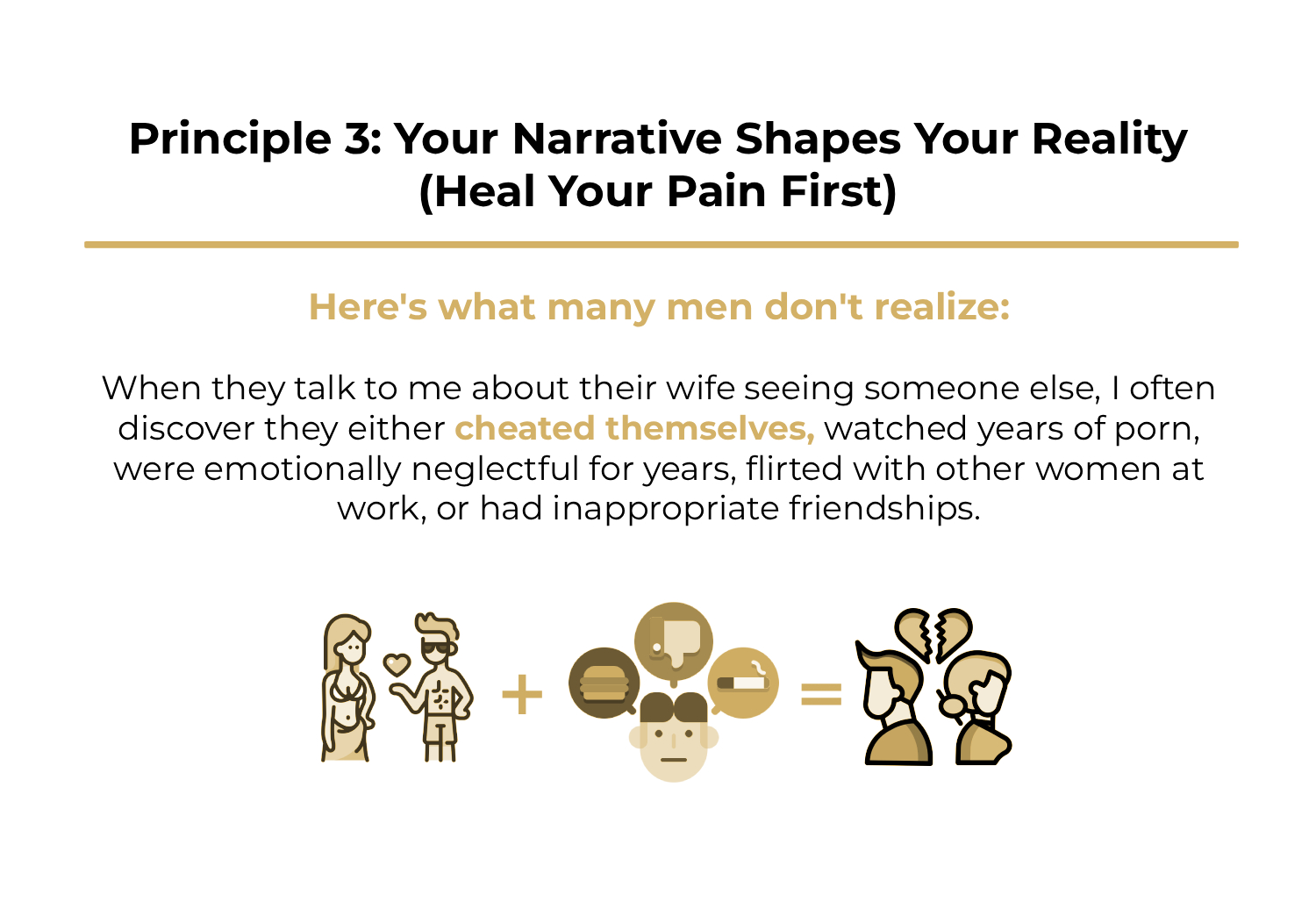
Here’s what many men don’t realize: when they talk to me about their wife seeing someone else, I often discover they either cheated themselves, watched years of porn, were emotionally neglectful for years, flirted with other women at work, or had inappropriate friendships.
Then they ask, “How could she do this to me?”
If you don’t process this pain now, you’ll replicate the same patterns with the next woman. The pain goes back further than your wife. But you have to start in the present.
How These Principles Work Together
These three principles create a compounding effect.
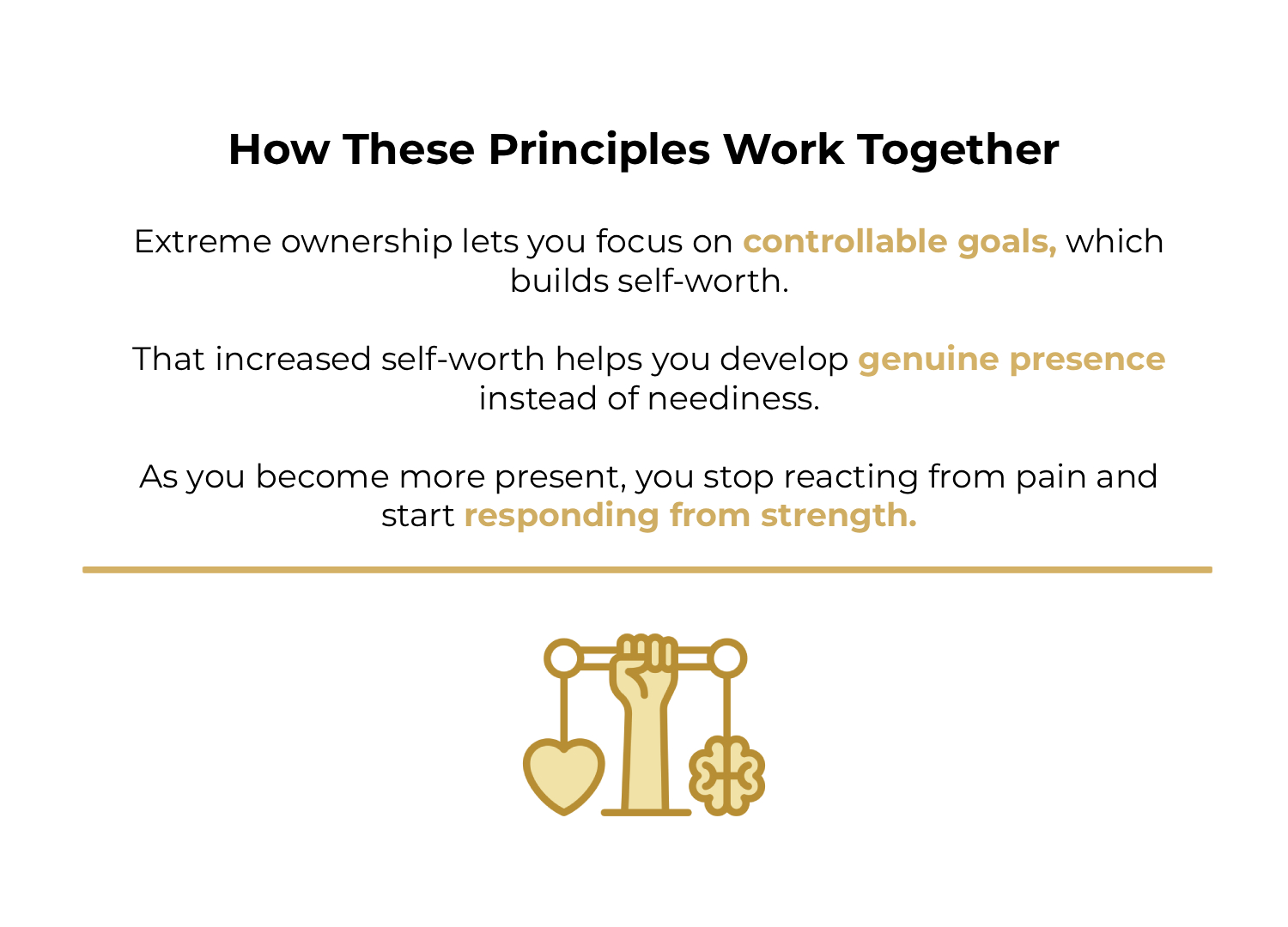
Extreme ownership lets you focus on controllable goals, which builds self-worth. That increased self-worth helps you develop genuine presence instead of neediness. As you become more present, you stop reacting from pain and start responding from strength.
The man who had one glass of wine after 60 days didn’t ruin everything. But his response mattered. He could have blamed his wife for drinking. Instead, he owned his choice and kept growing.
That’s the difference.
You don’t need a new strategy. You need to embody these three principles until they become automatic. That’s when transformation happens, not just for your marriage, but for who you are as a man.
The Four Checkpoints of the ERM Method
Our Emotional Reset Method uses these principles as foundation, then applies them through four specific checkpoints:
- Identify what you actually control in your current situation
- Develop presence skills through daily practice, not theory
- Process your pain before it drives your decisions
- Take consistent action from strength, not neediness
Men who work through these checkpoints often see their wives begin to soften within weeks. Others take months to rebuild trust after years of damage. The timeline varies, but the pattern holds.
Common Mistakes That Keep Men Stuck
Mistake 1: Temporary effort followed by complacency. You make changes so she can see you’re different. Things improve slightly. Then you slip back. She loses more trust each cycle.
Mistake 2: Using masculine approaches for feminine problems. You try to logic your way to emotional connection. You create systems for intimacy. You treat your marriage like a problem that needs a strategic solution.
Mistake 3: Reacting from unprocessed pain. Every decision made from hurt creates more hurt. You lash out, withdraw, or say things you regret because you haven’t paused to heal first.
Mistake 4: Tracking her changes instead of yours. You monitor whether she’s softening, giving you attention, responding differently. Meanwhile, you’re not building the internal foundation that makes lasting change possible.
FAQ
Q: What if I’ve already tried working on myself and nothing changed?
You probably worked on the wrong things or didn’t stick with it long enough for her to believe the change is permanent. Most men improve temporarily, then backslide. The question isn’t whether you’ve tried, but whether you’ve taken extreme ownership, developed emotional presence, and healed your pain. Those three shifts tend to separate temporary effort from lasting transformation.
Q: How long does it take to see results using these principles?
Results vary with effort and context. Some men see their wife soften within weeks as they embody these changes. Others take months to rebuild trust after years of damage. The timeline matters less than your commitment to becoming this version of yourself regardless of her response. When you stop needing a specific outcome and focus on your own growth, that’s often when she starts noticing.
Q: What if my wife won’t participate in fixing our marriage?
That’s actually good news. These principles don’t require her participation. You can’t control whether she goes to therapy, reads books, or works on herself. But you can control your own transformation. Many men in our program started with wives who’d completely checked out. As they embodied these principles, their wives gradually began to reengage. Not because the men manipulated a result, but because genuine change is naturally attractive.
Q: Is it too late if we’re already separated or she’s mentioned divorce?
Separation or divorce threats often mean she’s leaving who you’ve been, not who you’re capable of becoming. The question is whether you’re willing to do the deep work these principles require. Some of our biggest transformations started from separation. The key is focusing on your growth without needing her to validate your progress or guarantee a specific outcome.
Ready to Make This Real?
If you’re tired of the cycle of temporary improvement followed by backsliding, these three principles offer a different path. One that puts you in control of your growth regardless of her response.
Many men find these principles make sense intellectually but struggle to apply them in the moment when emotions run high. That’s where coaching support makes the difference. Our private community of over 1,000 men provides the accountability and real-time feedback that helps you embody these shifts, not just understand them.
If you want structured coaching and clear next steps, consider a Marriage Evaluation Call to review your situation and what you can control next. We work with committed men who are ready to take extreme ownership and transform themselves. We don’t accept every applicant because we protect our community carefully. Limited spots available each week.
DISCOVER THE 5 STEPS TO SAVING YOUR MARRIAGE
Even If Your Wife Already Filed For Divorce


